You would think it would be easier to get your child into an elementary or primary school than a prep or high school, right? Not exactly. Depending on where you live, demand for places in elementary schools may be greater than the supply. The other issue frequently encountered is the style of teaching. With all of these things and more in mind, let's explore what's involved in getting your child into private elementary school.
Supply and demand
Places for the best elementary schools are always going to be in demand. What do I mean by best schools? Mostly 'best' is a subjective description because there are no rankins of private schools available. Much of a school's reputation rests on things like its campus and facilities as well as the quality of the curriculum and teaching. It is amazing how word gets around about such things but it does.
If you live in cities like New York, Boston or Washington, you literally will need to put your child's name on the list shortly after birth in order to even get an interview at some of the most sought after schools. Well, I am exaggerating a tad. Perhaps not that soon, but don't delay calling the schools and finding out their admissions procedures. Do it well in advance. Two years ahead of time is not too early.
Determine the kind of school you want
This part of the process is the toughest. It is also probably the most important. It is tough because you will have many schools to choose from. It is the most important simply because you need to get it right. The last thing you want is to have to change schools every couple of years.
To make that all-important first cut, go online at this web site and start reviewing the schools which are available to you in your area. Refine your search by eliminating any schools which do not meet your requirements. Your requirements include such things as whether or not you want your child attending a faith-based school or a school which adheres to a specific educational philosophy such as Montessori or Waldorf. Once you have refined your search, you should end up with a list of 3-5 schools. The next step is to request materials from those schools, attend open houses and schedule interviews.
What kind of teaching do you want? There are basically two approaches to teaching at the elementary grade level:
- The traditional teacher-directed approach
- The student-centric approach
Each approach has its proponents and opponents. Let's look at each one in more detail.
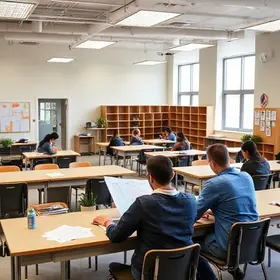
The traditional teacher-directed approach You will find the traditional teacher-directed approach in most elementary schools. The teacher determines what will be learned, how it will be learned and when it will be learned. The classroom reflects this more regimented view of how children learn. You will find desks and chairs all neatly lined up in rows, for example. Children are usually grouped by age level and by grade. The curriculum follows that kind of structured approach as well. 5th grade math is taught in 5th grade, 4th grade language arts are taught in 4th grade and so on. This is the way most of us have been taught. You may still feel that this is the best approach for your child.
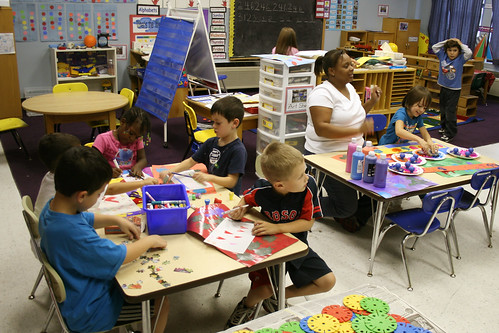

The student-centric approach which Montessori, Waldorf and progressive schools use a student-centric approach. What do I mean? In a student-centric classroom the teacher guides children in their learning process. But basically you will find children working on whatever they want to whenever they wish to. The day has broad blocks of time set out for learning and discovery. Students are typically grouped in multi-age classes encompassing several grades. You won't find a teacher at the front of the classroom looking out over rows of desks and smiling faces. You will find her sitting with a child explaining a math concept he has asked about. Or perhaps she is helping children to plant seedlings in the window garden.

 by Natashi Jay
You will find some schools which try to blend the best of both approaches. Whether that works or not has to be something you determine.
It is most important that you and the school be in harmony with regard to your mutual expectations. The goals of an elementary education should be:
- Teaching a child how to read and write
- Teaching a child how to interact with others
- Developing a sense of discovery and love of learning
The goal of elementary education is not to prepare your child for Harvard. Lay solid foundations for learning and inculcate good core values, and getting into Harvard will take care of itself.
The reality which every parent has to deal with is that the school can only do so much. Most of the teaching really is up to us parent. We do that by setting positive examples, by guiding our children as they make choices and y influencing them as they are increasingly exposed to different ideas and ways of looking at things.
"Let the child be a child."
It is a good rule to live by. Children are exposed to so much sex and violence in the popular media these days that one of the best things a parent can do is to carefully limit the amount of television, video and music your child has access to on a daily basis. If you buy into that approach to childraising, then you will look closely at the schools you select to see that they too embrace those values. Encouraging children to use their imaginations is what reading good books does. Interacting in a meaningful way with your children is always preferrable to sitting them in front of a video game or television show.
Parental involvement
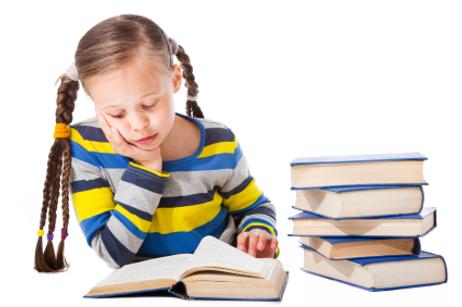
As I mentioned in passing above, the school can only do so much. We parents need to do the rest. We need to encourage our children to read. Spend time with your child every day. Read to her. Have her read to you.
We need to encourage active versus passive activity. Whether she is sitting in front of a television or using a tablet or listening to music on a handheld device doesn't much matter. Carefully limit those passive activities. Establishing the proper habits in the primary grades will cast the die for middle and high school. Hopefully the school which you have chosen will embrace your values. If it does, that will make your job so much easier.
Parental involvement also means that you will help out at the school as needed. Teachers plan classroom activities throughout the year which need parents to help out. Schools hold events to help raise money for various purposes. Be ready and willing to help as needed.
During the interview process express your willingness to help the school. Demonstrate that you are eager to be a partner in your child's education. Explain how you plan to support what the school does. Discuss your approach to supervising your child's activities. Talk about how you enrich her daily learning activities at home. Private schools value parents who understand that education is a partnership of three.
One final word about selecting an elementary school for your child: choose the school where both you and your child will be the happiest. That all-important happiness quotient is what will make all the difference. You need to decide what things really matter to you most. Since each private school is unique in just about every respect, that places the onus on you to get it right. Decide what matters most to you. Not to somebody else. Then make your decision based on those criteria.
Read about elementary education. Try to understand the different approaches and philosophies. Find out which you prefer. Ask questions. Lots of questions. Your child's elementary school years can and should kindle a passion for learning. When you and the school get it right, you will kindle a passion for learning which will last a lifetime.