Have you ever thought about starting your own private school? There are a couple of reasons why you might be pondering a large scale project such as starting a private school. Perhaps you are discouraged by the lack of education options in your area and want to do something about it. Maybe you have a vision and philosophy of education which is ahead of the curve. Rudolf Steiner and Maria Montessori are examples of educators who established entire movements based on their teachings and philosophies. Or perhaps no school in your area is doing what you know and feel strongly is necessary and beneficial for young people. Many determined people have established private schools because they want to be able to include religious instruction in their curricula. These are just a few of the reasons why private schools get their start.
Separation of Church and State
Historically this has been one of the major reasons why private schools were established. Public schools legally cannot teach faith-based religion. So if you are a devout follower of your religion, you will probably want your children to have a thorough grounding in their faith. That's why 22,731 private schools are affiliated with a religion according to the data available from the Private School Universe Survey of the National Center for Educational Statistics. To put that number of schools in context the PSS shows that there were 33,366 private schools in the United States. Based on those statistics religious private schools constitute 68% of the total number of private schools.
The largest number of religious schools are Roman Catholic with 22,731 schools. Coming in at a distant second place are Christian (non-denominational) schools with 4,602 institutions under that grouping. So, as you can see from the data, parents want their children to be brought up in their religion's beliefs, traditions, and teachings. The only way that can happen is by sending them to a private religious school of their choosing.
Here is a brief look at a Jesuit high school.
How do private religious schools get their start? Most of them begin as an outreach program sponsored by a local church or synagogue. As a result of the curriculum of these parochial schools, and indeed practically everything else is prescribed by and controlled by the local congregation's authorities.
On the other end of the religious private school spectrum are the church-affiliated private schools. These schools are owned and operated by an independent board of trustees. Examples include schools such as Kent School in Connecticut and Sidwell Friends in Washington, DC. Kent is affiliated with the Episcopal church which incidentally claims 381 schools under its aegis. Sidwell, which is the school President and Mrs. Obama's daughters attend, is affiliated with the Religious Society of Friends, more commonly referred to as Quakers.
Again, the curriculum and all matters pertaining to the administration of these schools are overseen by a board of trustees. Most of these schools are set up as tax-exempt corporations under section 501(c)(3) of the tax code. That enables them to accept donations that are tax-deductible.
Educational Philosophy
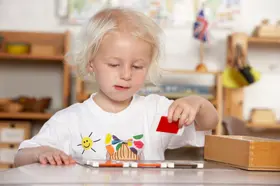
Educational philosophy is another reason why private schools have been established. Some parents with strong opinions about how they want their children taught will start a school that meets their requirements. The most familiar examples are the schools that follow the Montessori approach. Dr. Maria Montessori pioneered what in its time was a revolutionary way of educating very young children - toddlers through what today we would call middle school-aged children. Her ideas quickly caught on around the world. As a result, there are approximately 2700 Montessori schools in the United States according to the PSS survey. Waldorf schools and schools which follow the Reggio Emilia principles occupy this segment of early education together with the Montessori schools.
This short video introduces Montessori concepts.
Other types of private schools which were established because their founders wanted to follow a particular educational philosophy include the progressive schools. Progressive schools such as the lab schools are usually affiliated with a major university. Examples include totally independent institutions such as The Putney School in Vermont and Dalton School in New York City.
Choices
Many independent schools got their start in the suburbs because parents wanted programs and activities which were simply not available in their locality. Enriched curricula, extracurricular activities, and athletic programs are costly to offer and administer. In many cases, the local school district didn't offer much beyond the basics. Another factor is the class size. Most parents want their children to have as much face time with their teachers as possible. Private schools allow this essential part of teaching to happen. Examples of schools in this category include country day schools such as Rye Country Day School in Rye and Savannah Country Day School in Georgia. Add in the athletic programs and extracurricular activities that public schools increasingly have to cut and you can begin to see the rationale for a suburban private school. Many of these schools begin as an elementary school with grades PK through 6. Then they add on a grade at a time until they offer a full PK through the 12th-grade curriculum. The high school grades cost more to operate since they require labs and specialist teachers. So it makes sense to build the school out over five or six years. Still, other private schools focus on the high school years from the beginning. Much depends on the location of the school, the market conditions, and the funding. When all of these factors align, the school will get off to a good start.
Special Programs
Private schools have historically been established to offer special programs that are not generally available in the public sector. Private schools that specialize in teaching students with learning differences play an important role in education. These schools offer highly-trained, skilled teachers who work 1 on 1 or with very small groups of students to improve the outcomes. Other schools with a special emphasis include military schools. Most military schools are boarding schools. Fairly new on the scene are the Cristo del Rey schools which provide a low-cost high-quality education with a work-study component. Cristo del Rey schools are independent schools that are members of the Cristo del Rey network. More about these wonderful schools in this video.
In Starting a Private School I lay out the steps you need to take to start a private school. It's a major project as you can imagine but well worth considering. I had the wonderful experience of starting a school years ago. It truly was one of the most rewarding experiences of my career. If you are teetering on the fence about whether or not to proceed, do it. You will very glad you did.
Questions? Contact us on Facebook. @privateschoolreview