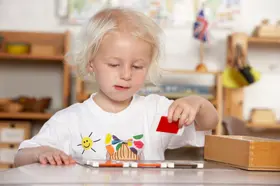

Progressive schools are different from traditional schools. Their educational philosophies and teaching methods are different. Because there are so few progressive schools, relatively speaking - only about 75 schools call themselves progressive - most people are surprised when they discover that these schools even exist.
First, here is some of the background on the progressive movement here in the United States. The easiest way to understand how progressivism got started in this country is to realize that educators were also philosophers. For example, the Vermont native John Dewey (1859-1952) who founded the University of Chicago's Laboratory School which many consider the flagship of progressive education, was a distinguished philosopher as well as an educator. In a nutshell, Dewey knew that education was the way to make sweeping changes in society. After he had left the University of Chicago, Dewey founded The New School in New York. The foundation of Dewey's approach to education rests on three lectures he gave back in the 1890s to raise money for his Laboratory School. The School and Social Progress, the School and the Life of the Child, and Waste in Education put forth Dewey's fundamental beliefs that education needs to be an interactive process in which the child discovers the relevance of his lessons to the real world outside.
This video offers an overview of John Dewey and his educational philosophy.
Dewey did not like the segmentation of education as it progressed from the kindergarten years to high school. He espoused a unified approach that would ultimately produce capable young adults who could think critically and achieve all the things a democratic society expected its citizens to accomplish. While Dewey's ideas make sense to 21st-century readers, they were revolutionary in their day. Back then, infants entered kindergarten where they enjoyed a variety of activities designed to encourage them to explore the world around them. In the primary grades, they were expected to learn the rudiments of mathematics and grammar largely by rote. Then in the upper school years, students learned Latin, history, rhetoric, and religion. In essence, Dewey believed that learning by discovery and applying those lessons learned to the world around them was the pedagogical approach that should be used throughout a child's school years.
Against that backdrop, here are five facts about progressive schools which I hope will encourage you to find out more about progressive education and to learn why it may be the best option for your child.
1. Most progressive schools don't issue report cards.
Professor John Dewey disliked the notion of children sitting in rigid rows listening to a teacher, memorizing facts, and regurgitating those facts on command. Dr. Dewey felt that students needed to learn by doing. Implicit in this philosophy of education is an aversion to testing and report cards. You will monitor your child's progress in other ways. Instead of receiving a document with traditional grades such as A's and B's you will receive a reporting detailing your child's achievements in a variety of areas which the school feels are important.
2. Montessori, Waldorf, and Reggio Emilia schools are progressive schools.
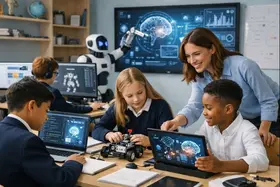
Intrinsic in Montessori education is the idea that a child needs to explore and discover to learn. Montessori classrooms guide learning. The teacher does not direct the learning. She guides it. Classes are multi-age so that a younger child learns from older children. Waldorf schools are world-famous for developing children's imaginations. Reggio Emilia inspired schools to emphasize the involvement and collaborative aspects of educating their students. These are approaches and ideas not usually found in traditional schools.
This video gives us a look at a Montessori classroom.
3. Lab schools are progressive schools.
A lab school by definition is a school attached to a university's college of education. It is a place where teachers can experiment with new and different methods and approaches to education. They can put theory into practice while under the watchful eye of seasoned professionals who know a thing or two about education and pedagogy. Over the years, many lab schools have separated from their original university affiliations and developed their own administrative and governing bodies under the progressive education banner.
This video offers an overview of the lab school experience.
4. Graduates from progressive schools matriculate to college.
Even though there are no AP courses offered in most progressive high schools, graduates from progressive schools tend to get into the colleges to which they apply. Instead of spending months, even years, learning material that will be the subject of a series of standardized tests in the spring of their senior year, students in a progressive school typically will undertake in-depth exploration and study of English, history, languages, and all the other subjects one would expect. The difference is that these subjects become the means for developing critical thinking and an understanding of the world at home and abroad.
5. Progressive schools are not permissive schools.
The notion that students in a progressive school are somehow not academically disciplined is simply not true. The point of progressive education is to allow young people the opportunity to experience ideas and things for themselves, as opposed to just reading about it and memorizing the facts.
Experiential learning is a vital part of progressive education. But banish any visions of your little darling doing whatever she wants to do whenever she wants to do it. That's not the way it works. Progressive schools have a strong sense of community. The school expects everybody not only to learn and play together but also to do the physical work necessary to make their school community a better place. A progressive school is not just an institution where you learn in an academic setting. It is a place where learning takes place while camping, gardening, or participating in a host of activities designed to bring out the full potential of each child.
Progressive education is not for every child. Indeed, it might not be right for your child. However, you will never know if that statement is true unless you visit a progressive school and see how it functions. The Putney School expresses the essence of progressive education succinctly:
"Progressive educational thought stems from the work of John Dewey and has as the central tenet the education of engaged citizens for a democratic society. Progressive schools value the diversity of thought and culture, as well as a commitment to equity and justice. At Putney we have a program that fosters personal initiative and adaptability, engaging all parts of a student’s development, not just the academic part. The culture embodies respect for the individual and the rewards of participation in a community."
Questions? Contact us on Facebook.. @privateschoolreview