
Finding the right private school for your child is a major process in and of itself. It is time-consuming with lots of steps, deadlines and forms to fill out and submit. Then, of course, you have to deal with the issue of how to pay for that private school education once you have identified the right school. Against this backdrop let's you and I figure out how to make the financial aid process work for us.
Start early
The key to success with any major project is to begin early. Taming the financial aid part of getting your child into private school begins with knowing how much you can afford to pay. Have that number worked out and clear in your mind. The most effective way at figuring out what you can pay is to review your income and expenses. Determine what you can afford to pay monthly for your child's tuition. Project that number also as an annual amount. Now bear in mind that this is a rough cut because what you are going to be doing very soon is completing the online documentation known as the Parents' Financial Statement or PFS provided by the School and Student Service (SSS) organization operated by the National Association of Independent Schools (NAIS). The PFS will require accurate financial information about your income, expenses, and assets as well as information about any other children who are in tuition-charging schools, i.e., private school. Having that rough idea of how much financial aid you need to ask
for is an important part of your discussions with the various schools you are looking at.
So start early. How early? If you are looking at having your child begin in the fall semester, then knowing what you can afford to pay 14 or 15 months prior to that fall start date is not too early. Why? Because you will be visiting schools during the summer 12 to 13 months before she starts school. If you are considering a school that has rolling admissions, it is even more important to have the financial aid part of the process settled as soon as you can. If you are looking at schools with fixed admissions deadlines in January, then you have a month or two more.
Deadlines are extremely important when it comes to anything but especially when it comes to asking for financial aid and submitting all the documentation required.
Gather documentation
Most private high schools will use the Parents' Financial Statement to prepare a profile of your income, expenses, and assets. How does the PFS work? In their own words:
"We estimate the amount you can contribute to school expenses and forward that estimate to the schools where you're applying. It's one form, for one fee, for any number of siblings, for any number of schools." ....Home for Parents
Using PFS
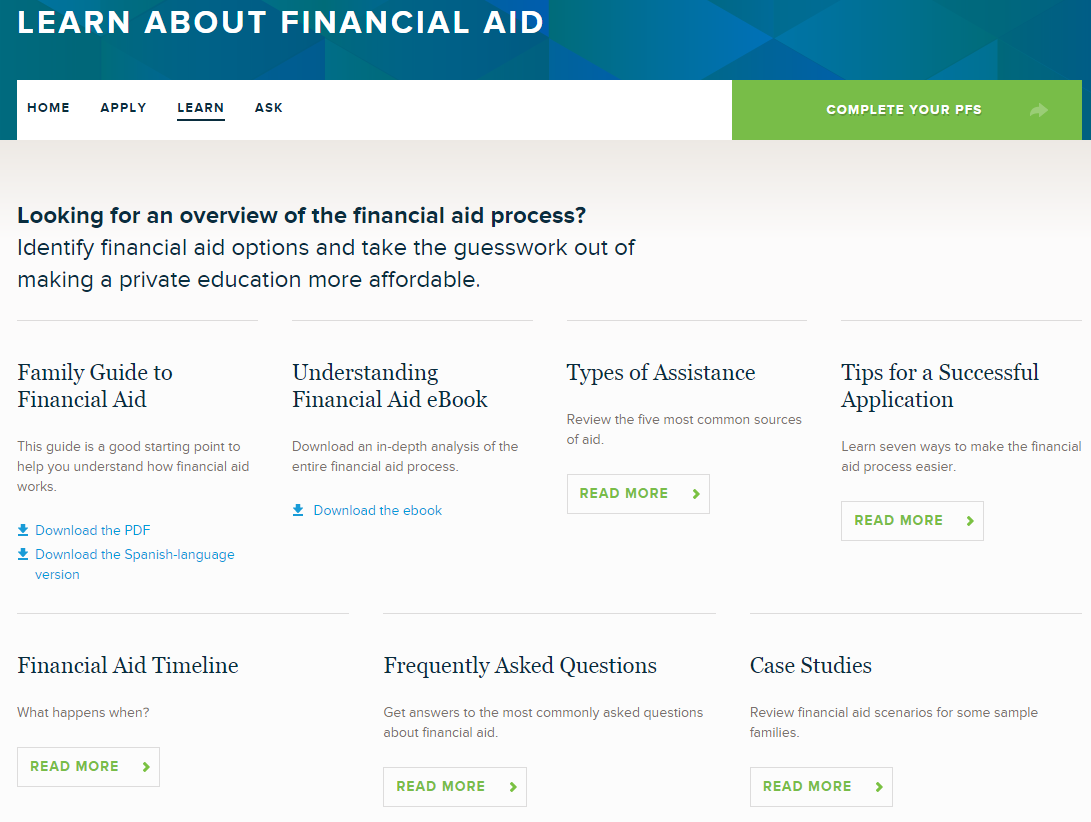
The PFS web site contains information and answers to just about every question you might have. Because it contains so much information, review it over several sessions. Try to understand how to apply and what you need to apply several months before you actually have to do that. You will find this part of the private school search process much less intimidating if you do. This screenshot shows you how comprehensive the PFS site is. Take your time and explore it thoroughly.
Ask for aid
You would think asking for aid is simple enough now that you understand how much money you need, right? Not so fast! That's because each school decides how much financial aid it will give you. As a result, the amount of financial aid you will be awarded typically varies from school to school. Why? One of the reasons financial aid varies from school to school is that each school has its own pool of money allocated for financial aid. The other reason is that each school has different numbers of applicants for financial aid.
Here's a hypothetical example: School A has $100,000 in its financial aid budget and 30 families needing financial aid. School A will divide up its $100,000 using the PFS estimates of what the various families can afford as a guide to how much each award will be. In the end, the total amount of the financial aid awards cannot exceed the amount allocated for financial aid, which in this example is $100,000. School B will use the same method for allocating financial aid but because it has more money and fewer students applying for financial aid the amount it will award applicants will differ from those awarded by School A.
Where does the money for financial aid come from?
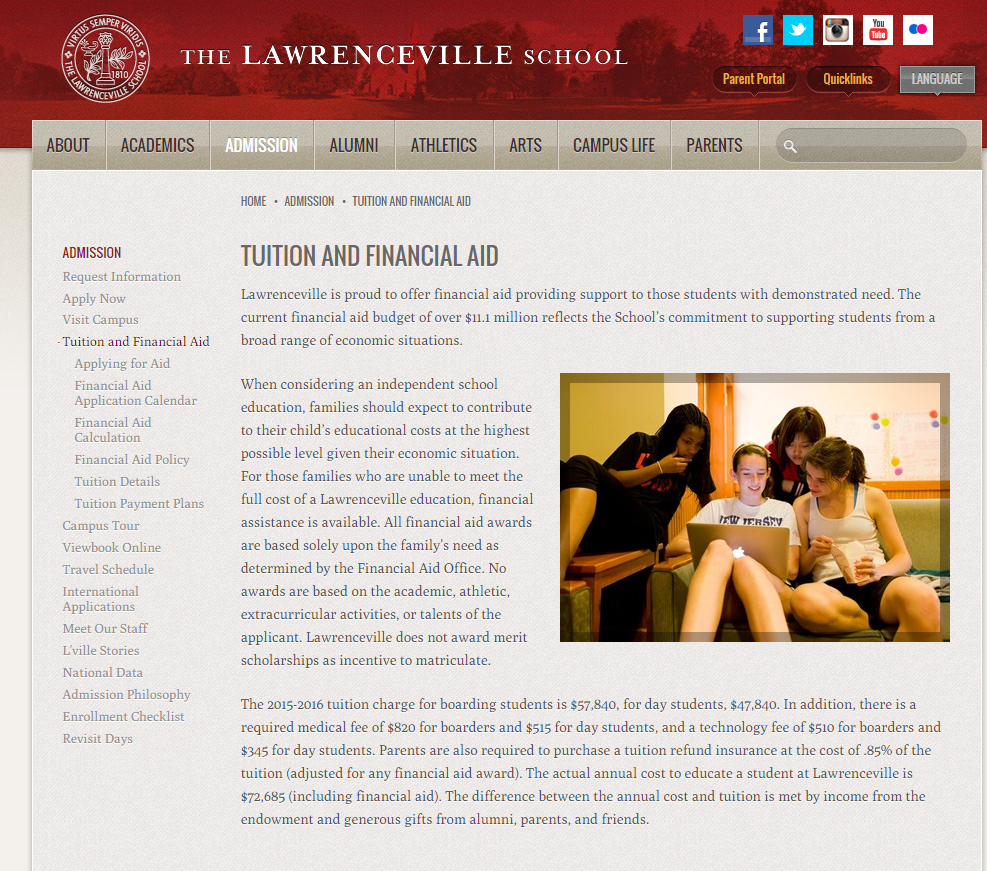
Most of the time the money which schools use for financial aid comes from endowments which the schools have as well as from generous gifts from graduates and other friends of the school. Over the years graduates will have given gifts specifically earmarked for financial aid. I am giving you the overview here. Obviously where financial aid funds come from depends on the individual schools and how they manage their finances. This example of how the financial aid program at The Lawrenceville School works is instructive.
How do I know that we will receive financial aid in subsequent years?
All things being equal and assuming that your financial circumstances do not change or change very little, you will apply for financial aid for subsequent years following the same process which you used for the first year.
Do schools give financial aid based on athletics academics or other factors?
Most, if not all private schools award financial aid strictly based on need. Essentially the same question is pondered with every financial aid request: how much can this particular family afford to pay and how much can we give them? As noted earlier the Parents' Financial Statement provides schools with the basic information which they need in order to assess what you can afford to pay. That basic information, however, is only a starting point in the financial aid discussions.
Other ways to pay for private school.
There are several other ways to pay for a private school education. I explain those in detail in 5 Things You Didn't Know About Financial Aid.
Questions? Contact us on Facebook. @privateschoolreview