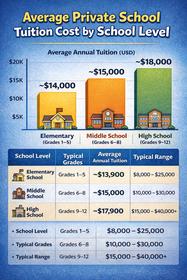

Private school tuition ranges from a few thousand dollars per year to well over $50,000, leaving many parents wondering whether paying more automatically leads to a better education. Premium independent schools often boast impressive campuses, renowned faculty, and extensive extracurricular offerings, while many mid-tuition private schools quietly produce exceptional academic and personal outcomes at a fraction of the cost.
The reality is that tuition alone is a poor measure of educational quality. Families should instead consider student outcomes, school culture, individual support, and how well a school matches their child's needs.
Before comparing schools, it helps to understand how tuition varies nationwide. Private School Review's guide to Average Private School Tuition Cost in 2026 explains current tuition ranges and why costs differ so dramatically across the country.
Understanding the Difference Between Mid-Tuition and Premium Schools
There is no universal definition of a "premium" private school, but many schools charging $35,000 to $60,000 or more annually fall into this category. These schools often feature expansive campuses, highly specialized facilities, extensive arts and athletic programs, and significant financial resources.
Mid-tuition schools generally charge between $10,000 and $25,000 annually, although costs vary by region. Many are independent day schools, faith-based schools, Montessori programs, or smaller college preparatory schools.
The difference in tuition usually reflects operating costs, facilities, location, faculty compensation, and available programming rather than a guaranteed difference in educational outcomes.
Does Higher Tuition Produce Better Academic Results?
Research consistently shows that student success depends on many factors beyond tuition. Motivation, family engagement, teaching quality, curriculum, and school culture all influence academic achievement.
Premium schools may offer:
- Smaller class sizes.
- More Advanced Placement, International Baccalaureate, or specialized electives.
- Expanded research, arts, and STEM opportunities.
However, many mid-priced schools provide equally rigorous academics with more personalized attention because of their smaller enrollments.
Rather than asking whether a school is expensive, parents should ask:
- How are graduates prepared for college?
- What is the average class size?
- How accessible are teachers?
- How much individual academic support is available?
These questions often reveal far more than tuition alone.
College Admissions Tell Only Part of the Story
Elite private schools frequently publicize admissions to highly selective universities. While these results are impressive, they do not necessarily prove that higher tuition caused those outcomes.
Students attending premium schools often enter with strong academic backgrounds, highly involved families, and significant educational resources outside the classroom.
Meanwhile, many mid-tuition schools consistently send graduates to excellent universities while helping students develop independence, leadership, and confidence.
Parents should evaluate college counseling programs, graduation requirements, and alumni outcomes instead of focusing solely on Ivy League acceptance lists.
Private School Review's article, Is Private School Worth the Money? ROI Guide 2026, explores how families can evaluate educational return on investment beyond prestige.
Where Premium Schools Often Stand Out
Higher tuition often supports opportunities that smaller schools simply cannot afford.
These may include:
- Extensive arts facilities: Professional-level music, theater, and visual arts programs.
- Advanced science laboratories: More hands-on STEM experiences.
- Large athletic complexes: Greater variety of competitive sports.
- Dedicated college counseling departments: Individualized application support.
- Global travel and exchange programs: Expanded international learning opportunities.
For students who will actively use these resources, the additional investment may provide meaningful value.
Where Mid-Tuition Schools Often Excel
Many moderately priced schools intentionally focus their budgets on classroom instruction rather than large campuses or luxury amenities.
These schools frequently offer:
- Strong teacher-student relationships.
- Smaller learning communities.
- Stable faculty.
- Excellent parent communication.
- Flexible academic support.
For many families, these characteristics have a greater impact on daily student success than premium facilities.
School Culture Often Matters More Than Tuition
Parents sometimes assume that expensive schools automatically provide a better experience. In reality, school culture frequently has a greater influence on student happiness and long-term success.
During school visits, families should observe:
- Student engagement.
- Teacher interactions.
- Classroom discussions.
- Campus atmosphere.
- Leadership opportunities.
A child who feels supported and challenged at a mid-priced school may thrive more than one who feels overwhelmed or disconnected at a more prestigious institution.
Private School Review discusses many of these broader considerations in The Pros and Cons of Private School in 2026.
Looking Beyond Tuition
The published tuition rarely represents the total annual cost.
Families should also consider:
- Technology fees: Yes.
- Athletics: Yes.
- Arts participation: Yes.
- Transportation: Yes.
- Uniforms: Yes.
- School trips: Yes.
Some premium schools include many of these expenses within tuition, while others charge separately. Mid-priced schools may also have additional fees, making it important to compare the full cost of attendance.
The article How Much Do Private Schools Cost? provides a detailed overview of expenses that families should include when budgeting.
Measuring Educational Value
Educational value extends well beyond college admissions.
Parents should consider:
- Student growth from enrollment to graduation.
- Availability of academic support.
- Leadership opportunities.
- Character development.
- Teacher accessibility.
- Overall student well-being.
Many schools with moderate tuition consistently deliver outstanding value because they allocate resources toward teaching excellence rather than maintaining expansive facilities.
According to the National Center for Education Statistics, school characteristics such as student-teacher ratios, enrollment, and instructional resources can provide useful context when comparing educational environments.
Similarly, the National Association of Independent Schools encourages families to evaluate mission, educational philosophy, and student fit rather than relying solely on reputation or price.
The admissions process itself also deserves careful consideration. The Enrollment Management Association guides families navigating private school admissions and evaluating school fit.
Questions Every Family Should Ask
Rather than asking whether one school is "better" because it costs more, parents should ask:
- What educational experience will best support my child's strengths?
- Will my child take advantage of the school's unique opportunities?
- Does the school's culture align with our family's values?
- Is the financial commitment sustainable for several years?
These questions often lead to better long-term decisions than comparing tuition alone.
Final Thoughts
Higher tuition can provide exceptional facilities, expanded programming, and broader extracurricular opportunities, but it does not automatically produce better educational outcomes. Many mid-tuition private schools offer outstanding academics, dedicated teachers, strong college preparation, and supportive communities that rival far more expensive institutions.
The best private school is not necessarily the one with the highest tuition. It is the one that aligns with a student's learning style, interests, goals, and family budget.
When comparing schools, focus on measurable outcomes, school culture, teacher quality, and student support rather than price alone. Doing so will help determine whether paying more truly delivers greater value for your child.