
Artificial intelligence is transforming education at a remarkable pace, and one of its fastest-growing applications is AI-powered tutoring. From personalized math instruction to instant writing feedback, these tools promise to give students individualized support whenever they need it. As more private schools incorporate AI into their academic programs, parents are beginning to ask an important question: Does AI tutoring improve learning, or does it introduce new risks?
The answer is not as simple as choosing between technology and traditional teaching. The most successful private schools are using AI tutoring as a supplement rather than a substitute for experienced educators. When thoughtfully implemented, AI can reinforce classroom instruction, identify learning gaps, and provide students with additional practice. However, concerns surrounding data privacy, academic integrity, and overreliance on technology remain significant considerations for families.
According to the International Society for Technology in Education (ISTE), artificial intelligence should enhance teaching and learning while keeping educators at the center of the educational experience. Similarly, the U.S. Department of Education has emphasized that schools should adopt AI responsibly, ensuring that technology supports educational goals without compromising student privacy or equity.
What Is AI Tutoring?
Unlike traditional online learning platforms that simply present digital lessons, AI tutoring systems adapt to each student's performance in real time. As students answer questions or complete assignments, the software analyzes their progress and adjusts future instruction based on individual strengths and weaknesses.
For example, a student struggling with algebra may receive additional practice problems and step-by-step explanations, while another student mastering the material quickly may be presented with more advanced concepts. This personalized approach allows students to work at a pace that matches their learning needs, often providing immediate feedback that would be difficult to deliver in a larger classroom.
Many private schools are beginning to integrate these adaptive learning platforms into regular instruction. As discussed in Technology in Private School Classrooms in 2026, AI is becoming one of several tools schools use to personalize learning while maintaining strong teacher involvement.
The Benefits of AI Tutoring
For many students, AI tutoring provides an additional layer of academic support rather than replacing classroom instruction. Students can revisit difficult concepts outside school hours, receive immediate explanations after making mistakes, and build confidence before returning to class.
Teachers also benefit from AI-generated insights. Many tutoring platforms produce reports that highlight where individual students are struggling, allowing educators to adjust lesson plans or provide targeted interventions before small misunderstandings become larger academic challenges.
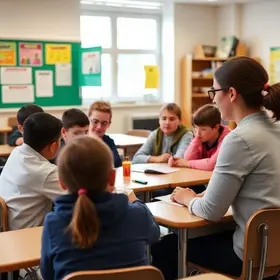
Private schools, which often emphasize individualized instruction and smaller class sizes, may be particularly well positioned to combine AI-generated data with personalized teacher support. Rather than relying solely on algorithms, teachers can use the information to make more informed instructional decisions while continuing to build meaningful relationships with students.
Schools that successfully integrate AI typically view technology as one component of a broader educational strategy rather than a replacement for human instruction.
Where Parents Should Be Cautious
Despite its promise, AI tutoring also raises legitimate concerns. One of the most significant involves the quality of the information students receive. While today's AI systems have become increasingly sophisticated, they can still generate inaccurate explanations or incomplete answers. Students who accept every response without critical evaluation may develop misconceptions rather than deeper understanding.
Another concern is the possibility that students become overly dependent on AI assistance. If tutoring platforms consistently provide answers instead of encouraging independent thinking, students may struggle to develop the analytical and problem-solving skills that remain essential for long-term academic success.
Privacy is another important consideration. AI tutoring systems often collect information about student performance, learning behaviors, and usage patterns to personalize instruction. Families should understand how this data is stored, who has access to it, and whether third-party vendors use it for purposes beyond education.
Parents interested in these issues can learn more in AI Data Privacy Policies in Independent Schools.
AI Cannot Replace Great Teachers
One of the biggest misconceptions surrounding AI tutoring is that it could eventually replace classroom teachers. In reality, most education experts see the opposite happening.
AI excels at repetitive tasks such as generating practice questions, tracking student progress, and providing immediate feedback. Teachers, however, contribute qualities that technology cannot replicate, including empathy, mentorship, classroom leadership, creativity, and the ability to recognize when a student needs encouragement rather than another practice exercise.
The strongest private schools continue to view AI as a tool that enhances teaching rather than replacing it. Educators remain responsible for designing lessons, fostering discussion, encouraging critical thinking, and helping students apply knowledge in meaningful ways.
This balanced approach is becoming increasingly common as schools adapt to changing technology. How Private Schools Are Adapting to Students with AI-Assisted Learning Habits explores how schools are updating policies while maintaining high academic standards.
Questions Parents Should Ask
When evaluating a private school's use of AI tutoring, parents should look beyond whether the technology is available and instead focus on how it is used.
Questions worth asking include:
- Is AI tutoring optional or integrated into daily instruction?
- How do teachers monitor student progress when AI tools are used?
- What safeguards protect student data?
- Does the school teach students how to evaluate AI-generated information critically?
- How are academic integrity policies updated to reflect AI-assisted learning?
Schools that can clearly explain their approach are often better prepared to use AI responsibly than those adopting technology simply because it is new.
Preparing Students for an AI-Driven Future
Artificial intelligence is likely to become a permanent part of higher education and many future careers. Helping students understand how to work effectively with AI, while recognizing its limitations, may become just as important as teaching traditional computer skills.
Forward-thinking private schools are beginning to incorporate AI literacy into their curriculum, helping students learn how AI systems function, recognize potential bias, verify information independently, and use these tools ethically. This emphasis prepares students not only to use AI effectively but also to think critically about its outputs.
Schools are also expanding conversations about responsible technology use, digital citizenship, and balanced screen time. Families interested in these broader trends may also find When "Personalized Learning" Is Mostly Software helpful for understanding the difference between meaningful individualized instruction and excessive reliance on educational software.
According to the National Center for Education Statistics (NCES), technology adoption continues to expand across American schools, making digital literacy an increasingly important component of a well-rounded education. At the same time, guidance from Common Sense Media encourages families and educators to balance digital innovation with healthy technology habits and age-appropriate use.
The Bottom Line for Private School Families
AI tutoring has enormous potential to enhance learning, personalize instruction, and help students receive timely academic support. Yet like any educational innovation, its effectiveness depends on how thoughtfully it is implemented.
Parents should look for schools that use AI to complement outstanding teaching rather than replace it. Strong AI programs combine personalized technology with experienced educators, clear academic expectations, transparent privacy policies, and instruction that continues to emphasize curiosity, collaboration, and independent thinking.
As AI continues to reshape education, the most successful private schools will likely be those that embrace innovation while remaining committed to the human relationships that have always been at the heart of exceptional learning.