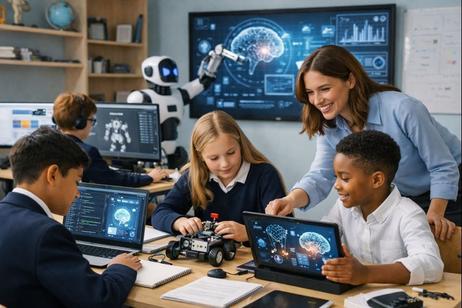
As the U.S. and global economies continue shifting toward automation and digital innovation, the skills students need to thrive in the workforce are rapidly evolving. Private schools across the country are responding with curriculum adjustments, new programs, and forward-looking approaches designed to help graduates succeed in an AI-driven job market. This article explores how schools are adapting, what skills are prioritized, and how these efforts align with federal guidance and broader labor trends.
Why AI Skills Matter for Future Careers
Artificial intelligence is no longer a buzzword reserved for Silicon Valley or advanced research labs. AI tools are embedded across industries, altering roles from healthcare and finance to manufacturing and creative arts. Employers increasingly seek graduates who understand how to collaborate effectively with AI systems and leverage technology in real-world problem solving. According to labor trend analysis, job postings requiring AI skills have grown significantly in recent years, reflecting expanding demand even at entry-level and increasingly specialized roles.
In this context, private schools are uniquely positioned to offer flexible, resource-driven environments that can innovate more rapidly than many traditional public systems. Parents and educators are keen to understand how these schools are rising to the challenge.
Federal Guidance on AI in Education
The U.S. Department of Education has acknowledged the transformative potential of AI in learning. In Artificial Intelligence and the Future of Teaching and Learning, the Department outlines recommendations to support schools, educators, and policymakers in harnessing AI responsibly. The report emphasizes integrating AI in ways that:
- Support personalized learning
- Extend teaching capacity
- Improve formative assessment and feedback
- Address policy, safety, and equity considerations
This guidance provides a framework that private schools can adapt to fit their missions and student populations.
Three Pillars of Preparedness in Private Schools
Private schools are advancing AI readiness through three primary strategies: curriculum innovation, skills enrichment opportunities, and partnerships with industry and higher education.
-
Curriculum Integration and Core AI Literacy
Forward-thinking private schools embed AI literacy across academic disciplines rather than confining it to elective tech courses. Key approaches include:
- Foundational technology courses that introduce students to computational thinking, data literacy, and algorithmic concepts
- Project-based learning that incorporates AI tools into research, analysis, and creative projects
- Ethics and digital citizenship instruction focusing on responsible use, bias in algorithms, and real-world implications of AI systems
Some private programs also encourage students to explore AI applications beyond coding, such as using analytics tools to interpret data in science labs or leveraging generative models for design and storytelling.
-
Specialized Pathways and Career Readiness Programs
Many private schools are launching specialized pathways that align with future workforce needs. Examples include:
- AI and Data Science tracks offering electives in machine learning, robotics, and predictive analytics
- Internships and mentorships with tech companies or university labs
- Dual-enrollment or early college programs that allow students to earn college credits in computer science and related fields
These programs help students connect academic knowledge with practical application, deepening their readiness for college majors and careers that involve intelligent systems and automation.
-
Professional Development for Educators
Effective AI education depends on teacher proficiency. While many schools have invested in AI tools, training faculty remains central to success. Nationwide, educator preparation for AI instruction is growing; in some districts, nearly three-quarters of schools expect to offer teacher AI professional development by fall 2025, highlighting expanded educator readiness overall.
Private schools frequently complement formal training with collaboration opportunities among faculty, bringing in external experts or partnering with universities to strengthen classroom practice.
What Skills Private Schools Are Prioritizing
Successful AI preparation extends beyond technical know-how. Private schools focus on multidisciplinary competencies linked to long-term career success, including:
- Critical thinking and problem solving: Analyzing complex challenges and devising innovative solutions
- Communication and collaboration: Working in teams that include both humans and AI tools
- Ethical reasoning: Understanding how AI impacts privacy, fairness, and equity
- Adaptability and lifelong learning: Navigating shifting career pathways and emerging technologies
This skills mix reflects broader trends showing that while AI may automate routine tasks, demand for higher-order cognitive skills and human-centered competencies continues to grow.
Comparing Approaches Across Schools
Below is a summary table contrasting common AI preparation strategies in traditional private school settings:
| Preparation Strategy | Focus Area | Typical Activities | Expected Outcomes |
|---|---|---|---|
| Curriculum Integration | AI literacy across subjects | Embedding AI concepts from humanities to science | Broad digital fluency |
| Dedicated AI Tracks | Technical depth | AI, coding, robotics coursework | Specialized career readiness |
| Project-Based Learning | Applied skills | Real-world problem projects with AI tools | Critical thinking & collaboration |
| Partnerships & Internships | Industry alignment | Work experiences with tech partners | Career insights & networking |
| Teacher Training | Educator capacity building | Professional workshops & certification | Improved instruction quality |
Evidence of Growing AI Readiness
National data and surveys reinforce the need for schools to prepare students for an AI-influenced labor market. Recent research shows significant expansion in educator training and increasing student familiarity with AI tools, though gaps remain in structured student instruction.
These trends highlight a broader education landscape where institutions that prioritize AI readiness may give their students a competitive edge in future career landscapes.
Challenges and Considerations
Despite progress, private schools face several challenges in implementing comprehensive AI education:
- Equity in access: High-resource schools often pioneer AI programs, but access may lag in smaller or less affluent institutions
- Balancing technology and fundamentals: Schools must ensure AI tools enhance, not replace, core literacy and reasoning skills
- Ethical frameworks: Responsible AI education requires explicit emphasis on fairness, bias, and societal impact
These considerations echo federal guidance on safety, equity, and governance in AI use.
Looking Ahead: 2026 and Beyond
As the job market continues evolving in 2026, private schools that invest in AI-related curriculum and experiences are better positioned to support student success. The integration of personalized learning platforms, real-world projects, and strategic partnerships can help graduates enter college and careers with the skills employers increasingly demand.
For families evaluating private education options, examining how schools prepare students for an AI-driven workforce is an essential dimension of academic quality and future readiness.
By presenting current approaches, federal guidance, and future pathways, this article aims to help parents, educators, and policymakers understand how private schools are preparing students for an AI-driven job market in 2026 and beyond.