Subject Specialization

Here, we examine the range of subjects and courses offered in private schools, including core academic subjects, electives, advanced placement (AP) courses, and specialized programs. This section highlights how schools cater to diverse interests and academic needs.

View the most popular articles in Subject Specialization:

How Private Schools Handle Dual Enrollment Courses

Updated
|
How Private Schools Handle Dual Enrollment Courses
Learn how private schools manage dual enrollment programs, college partnerships, scheduling, credits, and student support in 2026.

Dual enrollment programs are becoming increasingly common in private schools as families seek more advanced academic opportunities and early college exposure for high-achieving students.

In 2026, many private schools now partner with colleges, universities, and online higher education providers to allow students to earn college credit while completing their high school education. These arrangements can help students challenge themselves academically, reduce future college costs, and gain experience navigating college-level coursework before graduation.

At the same time, dual enrollment introduces important logistical, academic, and social considerations for private schools and families alike. Schools must carefully balance high school graduation requirements, student wellness, scheduling flexibility, and college readiness while ensuring students remain engaged in the broader private school community.

As explored in Academic Programs in Private Schools 2025, many independent schools are expanding advanced academic pathways to meet growing demand for personalized and accelerated learning opportunities.

Why Dual Enrollment Is Growing in Private Schools

Several factors are contributing to the growth of dual enrollment programs in independent education.

Families increasingly want students to:

  • Access more rigorous coursework
  • Explore academic interests early
  • Earn transferable college credit
  • Strengthen college applications
  • Experience greater intellectual independence
  • Reduce future college tuition expenses

Private schools also recognize that advanced learners sometimes outgrow available high school coursework, particularly in specialized STEM fields, advanced mathematics, world languages, and niche humanities subjects.

According to Private School Curriculum in 2025: Key Courses and Trends, individualized academic pathways and college-level learning experiences are becoming more common in competitive private school environments.

How Dual Enrollment
. . .read more

Project Based Learning in Private Schools Guide

Updated
|
Project Based Learning in Private Schools Guide
Explore project-based learning in private schools, outcomes, assessment methods, and what parents should expect in 2026.

Project-based learning has become a defining feature of many modern classrooms, particularly within independent education. As families explore academic options, understanding how project-based learning in private schools, outcomes, and assessment work in practice can offer valuable insight into a school’s teaching philosophy and effectiveness.

Unlike traditional instruction models that rely heavily on lectures and standardized tests, project-based learning, often abbreviated as PBL, emphasizes hands-on, inquiry-driven experiences. Students engage in extended projects that require critical thinking, collaboration, and real-world problem solving. In 2026, this approach is no longer experimental; it is a central strategy in many leading private schools.

What is Project-Based Learning?

Project-based learning is an instructional approach where students learn by actively exploring complex questions or challenges over time. Rather than passively receiving information, students take ownership of their learning through investigation and creation.

Key characteristics of PBL include:

  • Real-world relevance and authentic problems
  • Student-driven inquiry and research
  • Collaborative work and peer feedback
  • Integration of multiple subject areas
  • Public presentation or demonstration of learning

For example, instead of completing a worksheet on environmental science, students might design a sustainability plan for their school campus, incorporating data analysis, writing, and presentation skills.

This approach aligns closely with the broader shift toward experiential learning, which is discussed further in https://www.privateschoolreview.com/blog/category/programs-for-exceptional-learners.

Why Private Schools Are Embracing PBL

Private schools are often early adopters of innovative teaching methods due to their curricular flexibility. Over the past two years, many have expanded their use of project-based learning to better prepare students for higher education

. . .read more

How Private Schools Support Students with Learning Differences

Updated
|
How Private Schools Support Students with Learning Differences
Explore how private schools today support students with learning differences through specialized programs, expert staff, and evidence-based practices.

Private schools increasingly recognize that “one size fits all” instruction leaves many learners behind. Students with dyslexia, ADHD, dysgraphia, executive function challenges, or other learning differences need tailored support structures. In 2025, many private schools are adopting research-based practices, flexible resourcing, and inclusive policies that help students with learning differences not only survive, but thrive.

Why private schools can excel at supporting learning differences

Private schools often have structural advantages in delivering individualized support:

  • Smaller class sizes and lower student-teacher ratios, which allow for more personalized instruction.
  • Greater flexibility in curriculum and scheduling, enabling schools to adapt programming to student needs.
  • Independent governance, giving schools agility to adopt specialized models quickly.
  • Access to additional resources, such as specialists, assistive technology, and training budgets.

These strengths provide a strong foundation, but impact depends on how intentionally a school designs its learning support system.

Core Elements of Effective Support

  1. Early identification and assessment
    Many private schools partner with educational psychologists or specialists to assess students and create Individualized Support Plans (ISPs). These guide instruction and track progress with measurable goals.

  2. Structured, evidence-based instruction
    Leading schools adopt instructional models grounded in research. Structured literacy programs, such as Orton-Gillingham, remain the gold standard for dyslexia. The Association of LD Schools (ALDS) emphasizes personalized, multisensory teaching methods for students with learning differences (ldschools.org).

  3. Flexible delivery models
    Support typically blends three approaches:

    • Push-in support: specialists work alongside teachers in class.
    • Pull-out instruction: students receive small-group or one-on-one lessons.
    • Co-teaching models: teachers
. . .read more

Inside DoDEA Schools: Teacher Qualifications, Costs, and Accreditation

Updated
|
Inside DoDEA Schools: Teacher Qualifications, Costs, and Accreditation
Explore the world of Department of Defense Schools (DoDEA), offering quality education to military families globally. Learn about their history, academic performance, teacher qualifications, and unique benefits for service members' children.

Inside DoDEA Schools: Background

As someone who has taught various subjects and served as a deputy director in a private school, I can only imagine what it must be like to run a global educational system like the Department of Defence Schools (DoDEA). Let's look at the teacher qualifications, how much the tuition and costs are, and how the schools are accredited.

The Department of Defense Schools trace their roots to the aftermath of World War II.

  • In 1946, the Department of the Army established the first schools for dependents of service people in occupied Germany, Austria, and Japan.
  • These schools served children of American military personnel stationed abroad. Initially, the Army, Navy, and Air Force operated their schools separately.

Then, in 1964, the Secretary of Defense combined these into a single system.

  • The Defense Dependents Education Act of 1978 formally established the Defense Dependents' Education System, authorizing the Secretary of Defense to operate a free public education system for eligible overseas dependents.
  • This act provided Congressional authorization for the schools. Over time, the system has evolved.
  • In 1992 it became known as the Department of Defense Education Activity (DoDEA), incorporating overseas and domestic schools.
  • Today, DoDEA operates as a field activity of the Office of the Secretary of Defense, serving military families worldwide.

This video offers a look at the DoDEA schools in Europe.

Teacher Qualifications

DoDEA maintains high standards for its

. . .read more

The Value of STEM Programs

Updated
|
The Value of STEM Programs
The STEM subjects are now taught across curricula and integrated into the teaching of every subject at every grade level. More about STEM here.

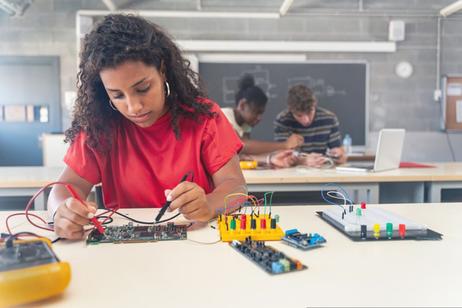
I've often wondered how my education would have turned out if computers and STEM had been part of the course offerings in the 50s and 60s. Of course, engineering is part of my DNA, with my father, uncles, grandfather, and great-uncles all having been chemical, mechanical, or civil engineers. Music and Latin were the subjects that interested me as a high school student. Fast forward to 1980. When IBM introduced the PC in 1980, I was awestruck. Then came the DARPA project called the Internet. I never looked back. I devoured technology and all its manifestations with an enthusiasm I had never experienced before. Against that personal backdrop, in this essay, I aim to see how I would integrate STEM subjects (Science, Technology, Engineering, and Mathematics) into my grandchildren's educations.

Why is a STEM education important?

An education in STEM (Science, Technology, Engineering, and Mathematics) is important for several reasons: Pair STEM with AI, and your students will be well-equipped to handle the career challenges of today's work environment.

It provides career opportunities

The workplace is changing rapidly. Education in STEM subjects can provide students with the skills and knowledge they need to pursue careers in fields that are in demand.

STEM extends far beyond the classroom. There are many places where STEM shows up in the real world, and many students already unknowingly engage with it in their day-to-day routines. Highlighting how everyday experiences can relate to their STEM education is another way of augmenting
. . .read more

Recent Articles

How Private Schools Handle Mid-Year Enrollment Changes and Tuition Refunds
Learn how private schools manage mid-year withdrawals, transfers, tuition refunds, enrollment contracts, and what families should expect financially.
Is Paying More Worth It? Mid-Tuition vs. Premium Private Schools
Compare academic outcomes, college admissions, class sizes, and value between mid-tuition and premium private schools to determine whether higher tuition delivers better results.
Financial Aid Appeals: When Should You Ask a Private School to Reconsider an Award?
Learn when and how to appeal a private school financial aid award, what documents to provide, and strategies that improve your chances of success.