
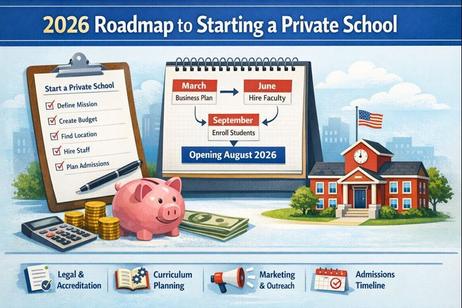
2026 Roadmap to Starting a Private School, Guide and Strategy
Launching a private school in 2026 requires more than a compelling educational vision. Founders must respond to shifting parent expectations, rising operational costs, evolving regulations, and increasingly competitive admissions cycles. Families are asking sharper questions about value, access, outcomes, and timing. At the same time, schools face pressure to differentiate while remaining financially sustainable.
This updated roadmap retains the strategic structure of prior guidance while reflecting current academic cycles, cost realities, and policy considerations. It is designed for founders, board members, and education leaders planning a new private school opening in the 2026 to 2027 academic year or beyond.
Clarify Your Mission and Market Position
Every successful private school begins with a clear mission that addresses a specific educational need. In 2026, that need is often tied to academic rigor, student well-being, and future readiness. Parents increasingly seek schools that balance strong academics with social-emotional learning, experiential programs, and transparent outcomes.
Market research should go beyond identifying nearby competitors. Analyze enrollment trends, tuition ranges, grade-level demand, and unmet needs in your region. Consider whether your school will serve a niche population, such as language immersion, STEM-focused learners, or students seeking smaller class environments, or whether it will compete directly with established independent schools.
Expert perspective from school consultants suggests that new schools with clearly differentiated missions reach enrollment stability faster than generalist models. Clarity also strengthens fundraising, admissions messaging, and faculty recruitment.
Build Governance and Legal Foundations Early
Governance planning remains one of the most underestimated steps in starting a private school. Establishing a legally compliant, mission-aligned board is essential. Most private schools operate as nonprofit organizations, requiring incorporation at the state level and federal tax-exempt status.
Founders should budget 9 to 18 months for full regulatory readiness. This includes bylaws, conflict-of-interest policies, insurance coverage, and compliance with state education requirements. Accreditation is not immediate, but aligning early with accrediting standards helps avoid costly restructuring later.
Develop a Realistic Financial Model
Cost transparency is now a primary concern for families and investors alike. Tuition alone rarely covers full operating expenses in the early years. In 2026, rising salaries, benefits, facilities costs, and technology investments continue to strain startup budgets.
A conservative financial model should project at least three years of operations and include multiple enrollment scenarios. Key expense categories include faculty compensation, administrative staff, facilities leasing or renovation, insurance, curriculum resources, and marketing.
National data from the National Center for Education Statistics shows that private school expenditures vary widely by region and school type, reinforcing the importance of localized budgeting rather than national averages.
Parents also expect clarity around financial aid. Even new schools are increasingly expected to offer need-based assistance, requiring thoughtful tuition discounting strategies from the outset.
Design Curriculum with Outcomes in Mind
Curriculum design should align directly with your mission and target families. In 2026, parents are less impressed by buzzwords and more focused on outcomes. They want to know how students progress, how learning is assessed, and how graduates are prepared for the next stage.
Whether offering a traditional college-preparatory program, Montessori approach, or project-based learning model, articulate how your curriculum supports academic growth, critical thinking, and character development. Schools that integrate experiential learning, technology literacy, and real-world application often resonate with modern families.
Alignment with recognized standards also supports future accreditation and transferability for students. Consulting established frameworks early helps avoid curriculum overhauls after launch.
Secure Facilities That Support Growth
Facilities planning must balance aspiration with practicality. Many new schools begin in leased or shared spaces, expanding as enrollment grows. In 2026, zoning restrictions, safety regulations, and accessibility requirements are closely scrutinized by regulators and parents alike.
Site selection should consider transportation access, outdoor space, and long-term expansion potential. Families increasingly evaluate schools based on environment, safety protocols, and learning spaces that support collaboration and wellness.
Operational leaders recommend selecting facilities that can scale incrementally rather than investing heavily in permanent infrastructure before enrollment stabilizes.
Hire Faculty Who Embody the Mission
Faculty recruitment is both a strategic and cultural decision. Teachers are often the strongest ambassadors for a new school. In a competitive hiring market, compensation, professional development, and mission alignment matter as much as credentials.
Parents want assurance that teachers are experienced, supported, and invested in the school’s philosophy. Clear hiring standards, onboarding processes, and evaluation systems help establish credibility from day one.
Founders should plan to hire key leadership roles, such as head of school and admissions director, at least a year before opening to ensure cohesive planning and community-building.
Plan Admissions and Enrollment Timelines Carefully
Admissions timing is a top concern for parents. Most private school families begin exploring options 12 to 18 months before enrollment. New schools must align their admissions calendars with regional norms to remain competitive.
Application deadlines, assessment practices, and enrollment contracts should be clearly communicated. Early decision incentives, transparent tuition policies, and responsive admissions communication build trust quickly.
Develop Marketing and Community Outreach Strategies
In 2026, digital presence is essential but not sufficient. Parents expect professional websites, virtual tours, and clear messaging, but personal engagement still drives enrollment decisions.
Community information sessions, partnerships with local organizations, and targeted outreach to feeder preschools or community groups can accelerate visibility. Testimonials from founding families and educators add authenticity during the startup phase.
Marketing efforts should emphasize mission clarity, student experience, and long-term vision rather than short-term promotions.
Create an Operational Launch Timeline
A detailed launch timeline keeps planning aligned and accountable. Working backward from opening day helps prioritize decisions and avoid last-minute compromises. Key milestones include regulatory approvals, faculty hiring, admissions launch, and facilities readiness.
Operational experts recommend scheduling contingency time for approvals and enrollment variability. Flexibility is critical, especially in the first two years.
Positioning for Long-Term Sustainability
Starting a private school in 2026 is both a mission-driven and business-oriented endeavor. Schools that succeed long term balance educational ideals with disciplined planning, transparent communication, and responsiveness to family needs.
Parents today value clarity, access, and outcomes. Founders who address these priorities directly are better positioned to build trust, achieve enrollment stability, and create schools that endure.
With careful planning, realistic financial modeling, and a clear understanding of today’s educational landscape, new private schools can thrive in an increasingly complex environment.