
The Admissions Process

This section outlines the step-by-step journey of applying to private schools, from understanding the overall process to preparing for interviews and meeting crucial deadlines. It offers valuable insights and tips to help applicants navigate each stage successfully.

View the most popular articles in The Admissions Process:

Enrollment Trends 2026: Private School Admissions Outlook

Updated
|
Enrollment Trends 2026: Private School Admissions Outlook
Enrollment Trends 2026 analysis explains why private schools are seeing enrollment growth or decline and what families should know.

Enrollment Trends 2026: What’s Causing Declines or Growth in Private School Admissions

Private school enrollment has entered a period of recalibration. Enrollment Trends 2026 reveal a sector shaped by demographic shifts, economic pressures, evolving parental priorities, and changing public education dynamics. For some schools, Enrollment Trends 2026 point to renewed growth and waitlists. For others, Enrollment Trends 2026 signal enrollment softness and increased competition for families.

Understanding Enrollment Trends 2026 is essential for parents evaluating private education, for school leaders planning strategically, and for educators responding to new expectations. While national enrollment numbers tell part of the story, Enrollment Trends 2026 vary widely by region, grade level, and school mission.

This analysis examines the forces shaping Enrollment Trends 2026, why some private schools are growing while others are contracting, and what these patterns mean for admissions in the years ahead.

A Snapshot of Enrollment Trends 2026

Enrollment Trends 2026 show a private school sector that is neither uniformly declining nor universally expanding. Instead, Enrollment Trends 2026 highlight divergence.

According to data from the National Center for Education Statistics and independent school associations, private school enrollment nationally remains below pre-pandemic highs, but stabilization is underway. Enrollment Trends 2026 indicate that early childhood and elementary programs are rebounding faster than middle and high school programs. Faith-based schools are seeing steadier Enrollment Trends 2026 than many independent secular schools, largely due to tuition affordability and strong community ties.

At the same time, Enrollment Trends

. . .read more

When to Apply to Private School, Admissions Deadlines for January and Fall

Updated
|
When to Apply to Private School, Admissions Deadlines for January and Fall
Learn when to apply to private school with clear guidance on admissions timelines, deadlines, and January and fall intake options.

When to Apply: Private School Admissions & Deadlines for January & Fall Intakes

Applying to private school requires early planning, consistent organization, and a firm understanding of admissions cycles. Families often underestimate how far in advance they should begin, especially when considering multiple entry points such as fall and January intakes. The target keyword appears throughout this article to help parents and students navigate when to apply to private school with clarity and confidence.

This guide outlines key timelines, typical deadlines, strategic considerations, and practical steps for both major intakes. It also includes annual updates and expert observations from the current admissions year.

Understanding Private School Admissions Cycles

Most private schools in the United States follow one of two primary admissions cycles.

Fall Intake (Traditional Entry)

The fall intake is the most common. Students start in September, aligning with the traditional academic year.

January Intake (Midyear Entry)

Some private schools offer a second entry point in January. These midyear options provide flexibility for families relocating, seeking a better academic fit, or transferring from public schools after the fall semester.

For foundational information, families can review how admissions processes work in general by visiting the guide on choosing a private school.

When to Apply to Private School for Fall Intake

Families should begin the process 12 to 18 months before the desired start date. The timeline below reflects typical admissions patterns used by many day and boarding schools.

Ideal Timeline for Fall Applications

Spring to

. . .read more

Post-Graduation Pathways Evolving for Private School Students

Updated
|
Post-Graduation Pathways Evolving for Private School Students
How private school graduates are rethinking post-secondary choices in 2025. Guidance for families as pathways diversify.

Evolving Post-Graduation Pathways for Private School Graduates Introduction

Families exploring private elementary, middle, and high schools increasingly want to understand how these schools prepare students for life after graduation. The traditional assumption that most private school seniors proceed directly into four-year colleges still holds for many, yet the landscape has become more varied, more intentional, and more individualized than it was even a decade ago.

This article examines how post-secondary planning is shifting for private school graduates, what is driving these changes, and how families can evaluate private schools based on the quality of their college counseling, preparation, and long-term educational guidance. It also offers practical recommendations for parents and educators as they help students chart purposeful pathways toward higher education.

Understanding the Shift

Private schools have long emphasized preparation for four-year colleges. Their rigorous academics, advisory systems, and counseling resources position graduates strongly for selective admissions. Yet in recent years, counselors report that students and families are reconsidering timelines, financial goals, and academic pathways. The result is a broader, more flexible approach to the college journey.

The shift is not away from college, but toward more personalized planning. Students are increasingly taking into account cost, readiness, mental health, academic fit, and long-term goals. As early as ninth grade, families are asking questions about pacing, preparedness, and alternative routes that support both academic and personal development.

What Is Driving the Change? 1. Cost and Value

. . .read more

Understanding Support Services in Private Schools

Updated
|
Understanding Support Services in Private Schools
A 2025 guide to academic, wellness, and college-counseling support services in private schools to help families evaluate school fit.

Support Services in Private Schools: What Counselors Need to Know in 2025

Private schools have long distinguished themselves by offering personalized attention and robust student support. In 2025, these services continue to expand in scope and sophistication, reflecting a deeper understanding of student wellness, learning variability, college planning, and social development. For families evaluating schools, and for counselors working within them, understanding these supports is essential for guiding students toward healthy, successful, and confident pre-college pathways.

This updated guide outlines the major support-service domains available in private elementary, middle, and high schools, what has changed in recent years, and how counselors can help students make the most of these offerings. It aligns with the mission of Private School Review, focusing on school evaluation, student outcomes, and informed decision-making.

Why Student Support Services Matter

Families often choose private schools for small classes, individualized attention, and structured academic environments. Yet the real differentiator increasingly lies in the wrap-around services that support academic, social-emotional, and college-preparatory needs.

Private school students encounter a wide range of challenges. Some require advanced academic opportunities, while others benefit from learning support, wellness resources, or structured guidance in navigating the admissions process to four-year colleges. By understanding how support services function within each school, counselors can provide meaningful direction and help families evaluate the overall fit.

Parents researching schools can benefit from exploring how institutions approach advising, communication, intervention, and long-term planning. Private School Review’s school profiles, for example,

. . .read more

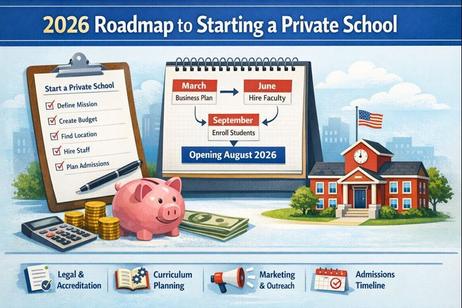
2025 Roadmap to Starting a Private School — Guide & Strategy

Updated
|
2025 Roadmap to Starting a Private School — Guide & Strategy
A 2025 step-by-step roadmap for launching your private school: strategy, funding, legal, curriculum, staffing, and sustainability insights.

A Roadmap for Starting a Private School in 2025

Launching a private school in 2025 requires not only a vision for academic excellence, but also a rigorous strategy to navigate evolving regulatory, financial, demographic, and competitive landscapes. Below, we update the classic roadmap to reflect 2025 realities, offering fresh insights, data, and real-world examples to guide founders, educators, and investors.

1. Clarify Mission, Vision & Market Niche

Reaffirm your “why.”
Begin with a clear mission: Are you founded on Montessori, STEM immersion, classical education, bilingual programming, or faith-based values? In 2025, parents increasingly seek schools that integrate social-emotional learning, global competency, and personalized pathways. A strong, differentiating mission helps you compete in a crowded marketplace.

Define your target market.
Conduct demographic research in your region: projected population growth in families with school-age children, income levels, and competitor density. For instance, in many U.S. metro regions, private school enrollment has not grown substantially: as of fall 2021, roughly 4.7 million students (9 percent of all K–12) were enrolled in private schools. In 2025, modest enrollment expansion is expected, so carving a niche — e.g. a hybrid in-person/digital academy, focused special education, or flexible hours — can help you stand out.

Paint your “positioning statement.”
Your school’s value proposition must be concise: e.g. “A bilingual STEAM lower school for first-generation immigrant families” or “A college-prep classical high school with year-round internships.”

2. Legal Structure, Accreditation & Compliance

Choose a legal entity.
Many new

. . .read more

Recent Articles

Financial Aid 101 for Private School Families 2026
Guide to private school financial aid in 2026, with current costs, key planning timelines and practical steps parents need to maximize aid options.
Why Extracurricular Activities Matter in 2026
Discover why extracurricular activities remain essential in 2026, with updated research, costs, and admissions insights for parents and students.
How to Appeal for Financial Aid After Admission
Learn how to appeal for financial aid after admission to a private school, with expert steps, timelines, and 2026 updates for families.