Administrative

Here you'll find information on the administrative side of running a private school. We'll cover strategic plan development, state regulations, human resources and school safety. Learn more about the obstacles of taking over a struggling school, get tips on hiring a headmaster, and receive expert advice on dealing with bad press.

View the most popular articles in Administrative:

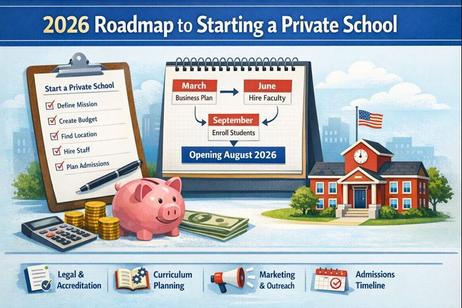
2026 Roadmap to Starting a Private School

Updated
|
2026 Roadmap to Starting a Private School
A 2026 guide to launching a private school, covering planning, costs, admissions timing, governance, and trends parents care about now.

2026 Roadmap to Starting a Private School, Guide and Strategy

Launching a private school in 2026 requires more than a compelling educational vision. Founders must respond to shifting parent expectations, rising operational costs, evolving regulations, and increasingly competitive admissions cycles. Families are asking sharper questions about value, access, outcomes, and timing. At the same time, schools face pressure to differentiate while remaining financially sustainable.

This updated roadmap retains the strategic structure of prior guidance while reflecting current academic cycles, cost realities, and policy considerations. It is designed for founders, board members, and education leaders planning a new private school opening in the 2026 to 2027 academic year or beyond.

Clarify Your Mission and Market Position

Every successful private school begins with a clear mission that addresses a specific educational need. In 2026, that need is often tied to academic rigor, student well-being, and future readiness. Parents increasingly seek schools that balance strong academics with social-emotional learning, experiential programs, and transparent outcomes.

Market research should go beyond identifying nearby competitors. Analyze enrollment trends, tuition ranges, grade-level demand, and unmet needs in your region. Consider whether your school will serve a niche population, such as language immersion, STEM-focused learners, or students seeking smaller class environments, or whether it will compete directly with established independent schools.

Expert perspective from school consultants suggests that new schools with clearly differentiated missions reach enrollment stability faster than generalist models. Clarity also strengthens fundraising, admissions messaging, and faculty recruitment.

Build Governance and Legal Foundations Early

. . .read more

How to Start a Private School in 2025: Complete K–12 Guide

Updated
|
How to Start a Private School in 2025: Complete K–12 Guide
A practical, updated guide to starting a private K–12 school in 2025, covering legal steps, planning, finance, and enrollment strategy.

How to Start a Private School in 2025: A Complete Guide

Starting a private K–12 school in 2025 requires thoughtful planning, compliance with state laws, strong community insight, and a sustainable operational model. This updated guide reflects the latest regulatory expectations, enrollment trends, tuition insights, and best practices to help founders create a thriving private school that serves families and students effectively.

  1. Understand the Role and Value of Private Schools

Private schools play a unique role in the U.S. education landscape. Unlike public schools, private schools are funded primarily by tuition, donations, and fundraising rather than government tax dollars. In 2025, about 9–10% of U.S. students attend private schools, equating to roughly 4.6 million learners nationwide. Private schools often offer smaller class sizes, specialized programs, mission-driven curricula, and unique educational environments that families seek as alternatives to public schooling. Public School Review+1

Private schools vary widely in focus, from faith-based missions to secular independent schools with rigorous academics. Most families choose private education for personalized attention, strong community expectations, and specific pedagogical approaches.

  1. Legal Requirements and State Regulations

### Know Your Regulatory Landscape

Private schools in the U.S. are regulated primarily at the state and local level. The U.S. Department of Education does not require federal permission to open a private school, but state departments of education and local authorities set the requirements for registration, reporting, health and safety inspection, teacher qualifications, and compulsory attendance compliance.

### State Registration and Compliance

Each state differs

. . .read more

How Private Schools Build Effective Internship and Industry Partnerships

Updated
|
How Private Schools Build Effective Internship and Industry Partnerships
A 2025 guide to how private schools develop industry partnerships for internships, career exploration, and real-world learning.

Industry Partnerships: How Private Schools Partner With Employers to Expand Internship Opportunities

Private elementary, middle, and high schools are strengthening their focus on real-world learning. Families increasingly expect schools to offer experiences that help students explore careers, build practical skills, and understand the workplace long before college. In 2025, internships and industry partnerships have become essential components of a well-rounded private school education.

This updated guide explains how private schools collaborate with employers, why these partnerships matter for students and families, which models work best, and what effective programs look like today. It also offers practical guidance for parents, educators, and school leaders who want to evaluate or improve internship opportunities.

1. Why Internship Partnerships Matter

Internships help students connect academic learning with practical skills. For younger students, early exposure builds confidence and motivates future academic choices. For high-school students, internships support college essays, demonstrate initiative, and help clarify academic or career interests.

For employers, partnerships with schools provide an opportunity to support their local community, develop future talent, and introduce students to growing fields such as advanced manufacturing, healthcare technology, cybersecurity, and environmental science.

For schools, internships strengthen curricular relevance, enhance college-counseling efforts, and help families understand the school’s commitment to student development beyond classroom instruction.

Internships also benefit students from a wider range of backgrounds when programs intentionally incorporate access, preparation, and mentorship. Schools that offer structured work-based learning can help level the playing field for students who may not otherwise have professional networks or

. . .read more

How to Start a Private School in 2025: A Complete Guide

Updated
|
How to Start a Private School in 2025: A Complete Guide
Learn how to start a private school in 2025—from mission and legal structure to tuition, accreditation and growth strategy.

Introduction

Starting a private school in 2025 is both a bold undertaking and a timely opportunity. With evolving demographic trends, rising tuition pressures and shifting policy landscapes, founders of new independent schools must balance vision and practicality. In this updated guide for PrivateSchoolReview, we reflect on how to start a private school today—drawing on recent national data, regulatory changes and real-world examples—to offer a comprehensive roadmap for educators, entrepreneurs and mission-driven leaders.

1. Define Your Mission and Educational Model

Your first step in starting a private school is to articulate a compelling mission and select an educational model that aligns with community needs and your institution’s identity. Will your school be a classical liberal-arts day school, a faith-based academy, a Montessori microschool, or a STEM-driven prep school? Clear answers to these questions help you highlight your unique value proposition—especially as competition among schools intensifies and families demand clarity and differentiation. Preschool through grade 12 private schools remain a rich market, with many founders instilling distinctive traditions, cultures and academic philosophies.

2. Legal Structure & State Regulation

While there is no single federal law governing private K-12 schools, your new school must comply with your state’s private school regulations. The U.S. Department of Education maintains a state-by-state directory of registration, licensing and private school oversight requirements.

You must select a legal structure: a nonprofit (e.g., 501(c)(3)), a for-profit corporation, or sometimes a hybrid form. Nonprofits benefit from tax-exempt status and donations; for-profits may offer more entrepreneurial

. . .read more

2025 Roadmap to Starting a Private School — Guide & Strategy

Updated
|
2025 Roadmap to Starting a Private School — Guide & Strategy
A 2025 step-by-step roadmap for launching your private school: strategy, funding, legal, curriculum, staffing, and sustainability insights.

A Roadmap for Starting a Private School in 2025

Launching a private school in 2025 requires not only a vision for academic excellence, but also a rigorous strategy to navigate evolving regulatory, financial, demographic, and competitive landscapes. Below, we update the classic roadmap to reflect 2025 realities, offering fresh insights, data, and real-world examples to guide founders, educators, and investors.

1. Clarify Mission, Vision & Market Niche

  • Reaffirm your “why.”
    Begin with a clear mission: Are you founded on Montessori, STEM immersion, classical education, bilingual programming, or faith-based values? In 2025, parents increasingly seek schools that integrate social-emotional learning, global competency, and personalized pathways. A strong, differentiating mission helps you compete in a crowded marketplace.

  • Define your target market.
    Conduct demographic research in your region: projected population growth in families with school-age children, income levels, and competitor density. For instance, in many U.S. metro regions, private school enrollment has not grown substantially: as of fall 2021, roughly 4.7 million students (9 percent of all K–12) were enrolled in private schools. In 2025, modest enrollment expansion is expected, so carving a niche — e.g. a hybrid in-person/digital academy, focused special education, or flexible hours — can help you stand out.

  • Paint your “positioning statement.”
    Your school’s value proposition must be concise: e.g. “A bilingual STEAM lower school for first-generation immigrant families” or “A college-prep classical high school with year-round internships.”

2. Legal Structure, Accreditation & Compliance

  • Choose a legal entity.
    Many new private schools in

. . .read more

Recent Articles

When a Private School Changes Head of School
A private school leadership change can raise important questions. Learn how to evaluate head of school transitions, identify warning signs, and protect your child's educational experience before enrolling confidently.
Private School Financial Aid Renewal: Could Awards Shrink?
Could your private school financial aid shrink next year? Learn why awards change, how income and school budgets affect renewal, and what parents can do to protect affordability long-term.
Need-Blind vs. Need-Aware Private School Admissions
Understand how need-blind and need-aware private school admissions affect acceptance decisions, financial aid eligibility, and affordability, with practical guidance to help parents compare schools, ask questions, and plan confidently ahead.

Running a Private School