
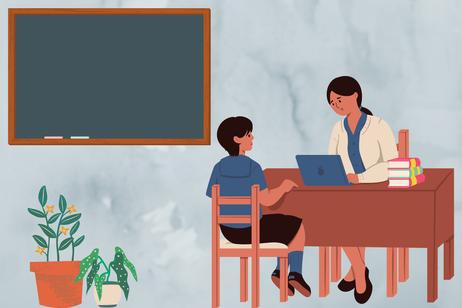
Small classes are one of private education's most familiar selling points. A school may advertise a low student-teacher ratio, individualized attention and faculty members who know every child. But those numbers do not necessarily tell parents how much teacher access their child will actually receive outside class.
Can a student meet a math teacher before tomorrow's test? Will an English teacher review an essay draft? If a ninth grader is confused for several days, does someone notice and arrange help, or is the student expected to initiate it?
For families evaluating private schools in 2026, teacher access deserves to be examined as a practical service rather than an abstract benefit. The strongest question is not simply how many students sit in a classroom. It is what happens when one of those students needs additional time.
Teacher Access Is Different From a Low Student-Teacher Ratio
A low student-teacher ratio can create favorable conditions for individual attention, but it does not guarantee availability outside scheduled lessons.
Consider two schools with similar ratios. At one, teachers hold regular extra-help periods, advise students, supervise study halls and remain on campus after classes. At another, teachers teach full schedules, coach activities and handle administrative responsibilities that leave relatively little unscheduled time.
The statistics look similar. The student experience may be very different.
This is why families should investigate the structure of the school day. Private School Review's overview of daily life for private school students illustrates how academics, advisory periods, lunch, extracurricular activities and study time compete for space in a student's schedule.
Teacher access depends partly on whether the school has deliberately created time for it.
Why Access to Teachers Matters
Extra help is not valuable only for students who are struggling.
A strong student might want to discuss a more sophisticated approach to a research paper. A ninth grader may need clarification about an assignment. A student returning after illness might need help catching up. Another may simply benefit from talking through a difficult concept without the pressure of asking questions in front of classmates.
Those interactions can also strengthen relationships.
Research summarized by the Institute of Education Sciences found that middle and high school students who experienced strong developmental relationships with teachers reported greater school connection and academic motivation and had better grades. The research also found that relationships tended to weaken over the school year without intentional efforts to strengthen them.
Teacher access, therefore, is not merely about getting homework questions answered. It can contribute to whether students feel known and comfortable seeking assistance.
How Much Teacher Access Does Your Child Actually Get?
Parents should look for concrete answers.
“Teachers are always available” sounds reassuring but is difficult to evaluate. A more useful answer might be: “Every teacher has three scheduled extra-help periods each week, and students can also make appointments during advisory.”
Ask when help is available and how students obtain it.
At some schools, teachers hold office hours before classes. Others build academic-help periods into the middle of the day. Students may be able to meet teachers during lunch, study hall or free periods. Boarding schools may offer additional evening access because faculty members often have residential or study-hall responsibilities.
The important question is whether access is predictable.
Students are more likely to use support when they know where and when it exists. A vague invitation to “come find me sometime” may work for confident students but not necessarily for younger, quieter or overwhelmed children.
Availability and Usability Are Not the Same
A school may technically offer extensive faculty access while making that access difficult to use.
Suppose extra help occurs at 7:30 a.m., but a day student's bus arrives at 7:55. Or teachers are available after school, but the student must immediately attend mandatory athletics. Perhaps several teachers schedule help during the same 30-minute period.
On paper, the school provides support. In practice, the child cannot reach it.
Ask current students how the system actually works. Do they regularly meet teachers outside class? How difficult is it to get an appointment during a busy week? What happens when athletics, rehearsals or transportation conflict with help sessions?
These questions are particularly important for families comparing schools that describe themselves as individualized. Private School Review's guide to comparing schools that advertise individualized education recommends looking beyond marketing language to determine what personalization actually means in practice.
Teacher access is one of the clearest ways to test that claim.
Extra Help Should Not Automatically Mean Tutoring
Families should also understand what teachers will and will not provide.
Routine extra help typically involves clarification, feedback or additional explanation related to the student's regular coursework. Tutoring may involve repeated, structured instruction over a longer period.
Those services are not interchangeable.
A teacher might happily spend 20 minutes helping a student understand quadratic equations but not have the capacity to provide three individual remediation sessions every week.
Research on structured tutoring illustrates why frequency and organization matter. An updated 2024 evidence review from EdResearch for Action found that effective high-impact tutoring generally involves frequent sessions, consistent tutors, curriculum alignment and ongoing use of student data. The brief notes that tutoring conducted during the school day tends to produce stronger attendance and academic outcomes than programs scheduled after school or during summer.
Private School Review's explanation of learning support versus tutoring can help families distinguish ordinary teacher assistance from more intensive academic services.
Pay Attention to Which Students Actually Seek Help
Access can exist without being equally used.
Some students will walk into a teacher's office and say, “I don't understand this.” Others will avoid asking until a small problem has become a serious one.
Age matters. Personality matters. So do confidence and previous school experiences.
Parents should ask what happens when a child does not initiate help independently. Do teachers invite students to extra-help sessions? Does an advisor monitor grades and missing work? Are parents contacted when a pattern develops?
The Institute of Education Sciences emphasizes active teacher behaviors in building relationships, including learning about students, interacting with them and showing genuine interest in their responses.
In other words, a strong support culture should not depend entirely on a 12-year-old having the confidence and organizational skills to request assistance.
Ask Whether Teachers Have Time to Provide the Access Promised
This is an important but easily overlooked question.
Teachers can only provide individualized attention when their workload permits it. A faculty member may teach several courses, advise students, coach a team, supervise lunch, run a club, attend meetings, communicate with parents and grade substantial amounts of student work.
Schools should therefore design faculty responsibilities with student access in mind.
Recent research underscores the importance of time and resources. A 2025 study indexed by the Education Resources Information Center reported that educators identified insufficient time, resources and support as barriers to addressing students' increased academic and behavioral needs.
During admissions conversations, parents can ask how many courses teachers typically teach and whether extra-help time is formally protected within faculty schedules.
That question may reveal more than asking whether teachers are “dedicated.”
Look Beyond Academic Help
Teacher access can also mean mentorship.
At many private schools, teachers serve as advisors, coaches, club leaders and dormitory faculty. A student may encounter the same adult in English class, at lunch, during advisory and on the athletic field.
These repeated interactions can help adults recognize changes that might be missed in a classroom alone.
A student who becomes unusually quiet, begins missing assignments or withdraws socially may be noticed sooner when teachers know that student across several settings.
The relationship dimension is supported by recent scholarship. A 2025 systematic review indexed by the Education Resources Information Center examined longitudinal research connecting teacher-student relationships with academic engagement, achievement and early school leaving, including outcomes for vulnerable student populations.
Families should therefore ask not only, “Can my child get academic help?” but also, “Who at this school will know my child well?”
What Happens When a Student Needs More Than Occasional Help?
This question separates informal access from an actual support system.
Imagine a student begins struggling in mathematics. The teacher meets with the student twice, but performance does not improve.
What happens next?
A strong school should be able to describe an escalation process. The teacher might consult the student's advisor, contact parents, recommend a learning specialist or coordinate with other teachers to determine whether the problem appears in multiple subjects.
Private School Review's article on understanding support services in private schools describes how advising, learning specialists, tutoring and other supports can work together rather than operating as isolated services.
This matters because generous teacher availability cannot substitute indefinitely for specialized intervention.
Questions to Ask Before You Enroll
Families do not need a lengthy checklist. A few specific questions can reveal a great deal:
- When can students meet teachers outside regular classes?
- Is extra-help time formally scheduled or arranged individually?
- What happens if athletics or transportation conflicts with those hours?
- Do teachers initiate meetings when they notice a student struggling?
- What happens when ordinary extra help is not enough?
- How often do students typically meet their advisors one-on-one?
Whenever possible, ask students as well as administrators. The official policy tells you what should happen. Students can tell you what usually happens.
Teacher Access Is a Better Test Than a Brochure Statistic
A student-teacher ratio is easy to publish. Meaningful access is harder to measure.
For parents, the goal should not be unlimited teacher availability. Teachers need planning time, professional boundaries and manageable workloads. Nor should students become dependent on constant adult assistance.
The goal is reliable access at the moments when it matters.
When comparing schools, find out whether your child can obtain clarification before confusion becomes failure, whether teachers notice students who hesitate to ask for help, and whether the school has a clear next step when ordinary assistance is insufficient.
Ultimately, the answer to “How much teacher access does your child actually get outside class?” should be more specific than “Our teachers really know their students.”
The strongest private schools should be able to show families when those conversations happen, how students reach teachers, and what the school does when a child needs more support than a classroom period can provide.