Financial Aid

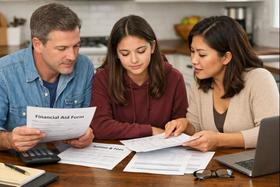
Paying for private school can be expensive and financial aid can be a huge help. Here we'll cover the financial aid options, how eligibility is determined and how it can affect the admissions process.

View the most popular articles in Financial Aid:

5 Things You Didn't Know About Financial Aid

Updated
|
5 Things You Didn't Know About Financial Aid
Financial aid can be complicated, even confusing, for most of us. But don't be intimidated by it. Here's how it works.

This article has been updated to reflect 2026 data and recent developments.

Financial aid can be very confusing for many parents. You wonder whether you make too much to be eligible. Is there a specific time when you apply? Here are five facts most of us didn't know about private school financial aid.

1. You have to apply for it.

Applying for financial aid at most private schools is a separate process from applying for admission to the school. You also need to make sure that you apply early. This is particularly important if the school has no specific admissions deadline or rolling admissions.

2. You may be eligible for free tuition if your family income is below a certain amount.

Exeter, Andover, Groton, St. Paul's, and Deerfield all have financial aid programs that offer a tuition-free education to qualifying admitted students. The threshold varies by school, with some schools offering free tuition to qualifying families earning $150,000 or less in 2026.

This video reports on free private school tuition.

Exeter offers $30 million annually in financial aid grants. Tuition-free attendance is available for families with incomes below $150,000.

3. There is a common application form.

Many private schools use a common financial aid form. This vastly simplifies the process of applying to several schools. You may have to fill out the Parents' Financial


. . .read more

Don't Need Financial Aid? Step to the Front of the Line!

Updated
|
Don't Need Financial Aid? Step to the Front of the Line!
The fallout of the economic and financial meltdown of 2009 was far reaching. Private schools did not escape the consequences either. But that may be a good thing for you.

Money always talks. When you pay cash for something, no matter what that something is, you will get a better deal. Or the vendor will offer a cash discount. Or perhaps you can negotiate better terms. Nowadays the same thing applies to getting into private school. Assuming that your child offers everything the school is looking for, if the school knows that you do not need any financial assistance, you can be virtually assured of acceptance. Why is that? What's changed?

This video reports on the ways that the pandemic has affected schools.

The Perfect Storm

World events have a direct impact on private school endowments. They can shrink as much as 20-30%, even more, when the stock market becomes a bear market. You and I can see how a school's finances are impacted by reviewing their tax returns, the Form 990. Form 990 is the tax return not for profit organizations file each year. Most schools file at the end of their fiscal year which typically is June 30.

Added to the market conditions are the vast numbers of jobs that have been shed as companies have folded or downsized. That means there are fewer parents able to afford private school without at least some financial assistance. Another factor is that many parents who were counting on sending their children to private school are scaling back their spending. The result is that there are fewer

. . .read more

Can I Ask For More Aid?

Updated
|
Can I Ask For More Aid?
This article addresses the common concern of requesting additional financial aid for private school education. It provides guidance on approaching schools during financial difficulties, exploring various aid options, and effectively communicating changed circumstances to secure more assistance for your child's education.

This article has been updated to reflect 2026 data and recent developments.

Many parents find themselves facing financial challenges when it comes to paying for their child's private school education. It can be especially difficult when circumstances change unexpectedly, such as a job loss, medical expenses, or a decrease in income. However, withdrawing your child from private school or immediately resorting to public school may not be the only option. Let's explore some alternatives and steps you can take in different scenarios.

Scenario A: Uncertain Job Situation

If you're facing uncertainty due to a job loss or potential layoffs, it's understandable to feel concerned about continuing with private school. Before making any decisions, consider reaching out to the school and discussing your situation. Many private schools have financial aid programs in place to assist families during challenging times. By openly communicating your concerns, you may find that the school is willing to work with you to find a solution. They understand the importance of education and retaining students, so they may be able to offer some financial assistance or flexible payment options.

Scenario B: Unexpected Medical Expenses

When unexpected medical bills arise and you find yourself in a financial bind, it can put additional strain on your ability to pay for private school tuition. In this situation, reaching out to the school and explaining your circumstances is crucial. They may be willing to reassess your financial aid package or offer additional support. Private schools are often compassionate

. . .read more

Charter Schools and Vouchers

Updated
|
Charter Schools and Vouchers
Are charter schools private schools? What do vouchers have to do with private schools? Some answers here.

Charter Schools

Is a charter school a private school? No. It is a public K-12 school. It receives public funding but operates without some of the arcane regulations most public schools must abide by. Read 10 Things To Know About Charter Schools. Charter schools can be found in most major urban areas. Some of them are well-run and funded adequately. Others have been a financial disaster. Charter schools tend to be small and have small class sizes.

Vouchers

The idea behind vouchers is to give lower income families an alternative to poorly performing public schools. Vouchers are a lightning rod in educational circles. Teachers unions universally despise them. Politicians avoid them. In places where voucher programs have taken hold, such as in Milwaukee and Cleveland, the response has been positive. The points of contention have to do with the use of public funds to pay parochial school fees and the diversion of public funds from public schools.

What vouchers are really all about is an attempt to provide some kind of school choice for parents with children in poorly performing public schools.

Fees and Financial Aid For Overseas Parents

Updated
|
Fees and Financial Aid For Overseas Parents
A brief look at fees and financial aid for overseas students.

Tuition at private schools ranges from $5,000 a year for primary grades in parochial schools to over $60,000 a year for boarding school. Like the wide range of private schools available, the costs vary greatly for several reasons. Sound management and healthy endowments are two major reasons some schools seem to be able to offer more for less.

Remember: American private schools receive no state funding, yet they must comply with all the laws and regulations which affect their daily operation. Retrofitting older buildings with new technologies, maintaining extensive physical plants, coping with soaring health and liability insurance, legal, and energy costs are just a few of the factors which come into play in determining tuition fees. While private schools are theoretically exempt from property taxes, most of them make substantial contributions to their local towns and cities to help offset the cost of maintaining police and fire protection. The overhead at a private school is enormous and complex with all the attendant impact on fees.

There are a host of ‘extras’ which also must be factored into the cost of an American private school education. Textbook and academic material fees, sports fees, clothing, uniforms, transportation to and from school, application fees – the list seems endless. Most schools will provide a breakdown of the ‘extras’ for you upon request.

Financial Aid

Financial aid for expats is generally not available. The assumption is that your company will pay for your child’s education as part of your compensation package.

. . .read more

Recent Articles

Changing Academic Tracks at Private School
Discover how your child can change academic tracks at private school without falling behind, including course prerequisites, transition planning, graduation requirements, academic support, transcript implications, and future college admission considerations.
When Private Schools Cannot Offer Advanced Subjects
Discover what parents can do when private schools cannot offer advanced subjects, including alternative courses, independent study, college partnerships, graduation requirements, and strategies for maintaining academic progress and future opportunities.
Child Refuses Private School Activities
Learn why children refuse private school group activities, how schools respond, when participation becomes mandatory, and practical ways parents can address anxiety, resistance, social difficulties, and student confidence effectively.