
Tuition and Costs

This subcategory explores the various aspects of private school tuition, including cost variations, reasons for price differences, and what parents can expect to pay for private education.

View the most popular articles in Tuition and Costs:

How Private Schools Handle Mid-Year Enrollment Changes and Tuition Refunds

Updated
|
How Private Schools Handle Mid-Year Enrollment Changes and Tuition Refunds
Learn how private schools manage mid-year withdrawals, transfers, tuition refunds, enrollment contracts, and what families should expect financially.

Changing schools in the middle of an academic year is rarely part of a family's original plan. Most students begin the school year expecting to remain through graduation or at least until the next admissions cycle. However, life does not always follow a predictable path. A new job in another city, unexpected financial hardship, health concerns, or a student's changing educational needs can make a mid-year transition unavoidable.

When families begin considering a withdrawal, one of the first questions is usually financial. Will the school refund any unused tuition? The answer depends on the enrollment agreement, the school's published policies, and the specific circumstances surrounding the withdrawal.

Understanding how private schools approach enrollment changes before making a decision can help families avoid misunderstandings and make the transition as smooth as possible.

Parents considering a transfer during the school year may also find Private School Review's guide to Navigating Private School Transfers Mid-Year 2026-27 helpful for understanding the admissions process at another independent school.

Understanding Enrollment Contracts

Every private school requires parents to sign an enrollment agreement before the academic year begins. While the wording differs from one institution to another, these contracts establish the financial responsibilities of both the school and the family.

Many parents understandably focus on tuition amounts and payment schedules when signing the agreement. However, the sections dealing with withdrawals and refunds often become the most important if circumstances change during the school year.

Unlike public schools, private schools rely heavily on tuition revenue

. . .read more

Is Paying More Worth It? Mid-Tuition vs. Premium Private Schools

Updated
Is Paying More Worth It? Mid-Tuition vs. Premium Private Schools
Compare academic outcomes, college admissions, class sizes, and value between mid-tuition and premium private schools to determine whether higher tuition delivers better results.

Private school tuition ranges from a few thousand dollars per year to well over $50,000, leaving many parents wondering whether paying more automatically leads to a better education. Premium independent schools often boast impressive campuses, renowned faculty, and extensive extracurricular offerings, while many mid-tuition private schools quietly produce exceptional academic and personal outcomes at a fraction of the cost.

The reality is that tuition alone is a poor measure of educational quality. Families should instead consider student outcomes, school culture, individual support, and how well a school matches their child's needs.

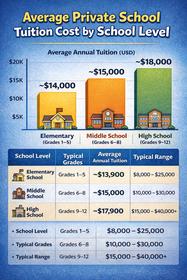
Before comparing schools, it helps to understand how tuition varies nationwide. Private School Review's guide to Average Private School Tuition Cost in 2026 explains current tuition ranges and why costs differ so dramatically across the country.

Understanding the Difference Between Mid-Tuition and Premium Schools

There is no universal definition of a "premium" private school, but many schools charging $35,000 to $60,000 or more annually fall into this category. These schools often feature expansive campuses, highly specialized facilities, extensive arts and athletic programs, and significant financial resources.

Mid-tuition schools generally charge between $10,000 and $25,000 annually, although costs vary by region. Many are independent day schools, faith-based schools, Montessori programs, or smaller college preparatory schools.

The difference in tuition usually reflects operating costs, facilities, location, faculty compensation, and available programming rather than a guaranteed difference in educational outcomes.

Does Higher Tuition Produce Better Academic Results?

Research consistently shows that student success depends on many factors beyond tuition.

. . .read more

The True Cost of 'Required' Private School Expenses Beyond Tuition

Updated
|
The True Cost of 'Required' Private School Expenses Beyond Tuition
Discover the required private school expenses beyond tuition and learn how to budget for the true cost of a private school education.

For many families, tuition is the number that dominates conversations about private school affordability. Admissions brochures and school websites prominently display annual tuition, making it easy to assume that this figure represents the total cost of attendance. In reality, tuition is often just the starting point.

Most private schools require families to pay a variety of additional fees that support technology, facilities, student activities, uniforms, transportation, and other essential services. While many of these expenses are disclosed during the admissions process, they may not be immediately apparent when comparing schools based solely on published tuition.

Understanding these required costs before enrolling allows families to create a more accurate budget and avoid financial surprises during the school year.

Why Tuition Doesn't Tell the Whole Story

Tuition primarily covers instruction and the day-to-day operation of the school. However, private schools also rely on additional fees to fund services and programs that enhance the student experience. These charges vary considerably from one institution to another, making it important to compare the total cost of attendance rather than tuition alone.

Private School Review's article on Costs of Private School in 2026 explains how required and optional expenses combine to create the true annual investment.

Enrollment and Registration Fees

Long before the first day of school, families often encounter application, enrollment, and registration fees. These one-time or annual charges help schools process admissions, secure a student's place, and manage administrative costs.

Although these fees may seem modest compared with tuition, they can add
. . .read more

How Policy Changes Could Affect Your Tuition Bill in 2026

Updated
|
How Policy Changes Could Affect Your Tuition Bill in 2026
Learn how federal and state policy changes may affect private school tuition, financial aid, tax benefits, and your family's education budget.

For many families, private school tuition is one of the largest annual educational expenses they face. While tuition typically increases because of inflation, faculty salaries, and facility improvements, government policy changes can also influence what families ultimately pay.

In 2026, several state and federal education policies are reshaping how private education is funded. Expanded school choice programs, tax incentives, financial aid reforms, and changes to education savings options are creating new opportunities for some families while introducing uncertainty for others.

Understanding these policy shifts can help parents make informed enrollment decisions, anticipate future costs, and maximize available financial resources.

If you're beginning your search, it is also helpful to understand strategies outlined in Private School Review's guide on How to Negotiate Private School Tuition Legally, which explains how schools evaluate affordability and financial aid.

Why Government Policy Matters to Private School Tuition

Unlike public schools, private schools operate independently and receive most of their revenue from tuition, donations, and endowment income. However, government policies can still influence what families actually pay.

Policy changes may affect:

  • State voucher and education savings account (ESA) programs
  • Tax credits for educational expenses
  • Rules governing 529 education savings plans
  • Financial aid reporting requirements
  • Scholarship availability
  • School operating costs

Although schools generally establish tuition independently, these outside factors can significantly change a family's net cost.

Expansion of School Choice Programs

One of the biggest developments in recent years has been the rapid expansion of school choice initiatives across multiple states.

Many states have broadened eligibility for Education Savings

. . .read more

How to Stress-Test a Private School Budget Before Enrolling

Updated
|
How to Stress-Test a Private School Budget Before Enrolling
Learn how to stress-test a private school budget before enrolling and avoid financial surprises that can affect your family's long-term plans.

Choosing a private school is often one of the largest financial commitments a family will make outside of purchasing a home. While tuition is usually the first number parents focus on, the true cost of private education extends far beyond the published price listed on a school's website.

Many families begin the admissions process confident that they can afford tuition, only to discover later that additional fees, annual increases, extracurricular costs, and changing family circumstances place unexpected pressure on their finances. A school that feels affordable during the enrollment process may become far more difficult to sustain several years later.

Before signing an enrollment contract, parents should take time to stress-test their private school budget. Doing so helps determine whether the investment remains manageable under a variety of real-world circumstances, not just under ideal conditions.

Looking Beyond the Tuition Number

The first mistake many families make is treating tuition as the total cost of attendance.

In reality, tuition often represents only one component of the overall expense. Depending on the school, families may also encounter registration fees, technology fees, activity fees, transportation costs, uniforms, books, field trips, athletic participation expenses, and fundraising expectations.

Private School Review's guide to paying for private school highlights why understanding the full financial picture is essential before making a commitment.

When evaluating schools, parents should request a comprehensive list of all anticipated expenses for the upcoming year rather than relying solely on advertised tuition rates.

Assume Tuition Will Increase

One of the

. . .read more

Recent Articles

How Private Schools Handle Mid-Year Enrollment Changes and Tuition Refunds
Learn how private schools manage mid-year withdrawals, transfers, tuition refunds, enrollment contracts, and what families should expect financially.
Is Paying More Worth It? Mid-Tuition vs. Premium Private Schools
Compare academic outcomes, college admissions, class sizes, and value between mid-tuition and premium private schools to determine whether higher tuition delivers better results.
Financial Aid Appeals: When Should You Ask a Private School to Reconsider an Award?
Learn when and how to appeal a private school financial aid award, what documents to provide, and strategies that improve your chances of success.