
Understanding Private School Costs: What Families Must Weigh in 2025
For many families, determining whether private school is the right educational investment begins with understanding cost. Tuition has continued to rise nationwide, and the landscape of financial aid, fees, and optional expenses has become more complex. Evaluating affordability requires more than looking at a school’s listed tuition. Families must assess the full picture, including academic value, school culture, long-term outcomes, and available support.
This updated guide outlines the key components and trade-offs families should analyze when considering day and boarding schools at the elementary, middle, and high school levels.
1. Understanding the Sticker Price: What Are You Paying?
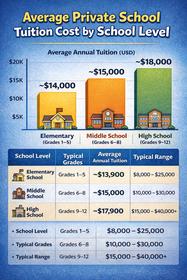
Private school tuition varies widely based on location, grade level, and program type. In 2025, national estimates place tuition averages approximately as follows:
-
Day Schools
Many day schools charge between $15,000 and $45,000 per year. Highly resourced schools in major metro regions often exceed $50,000. Early grades tend to be slightly less expensive than high school. -
Boarding Schools
Full boarding programs typically range from $65,000 to $75,000 annually, which includes room and board. Some specialized programs fall above or below this range depending on location and amenities.
Sticker price does not reflect the amount most families actually pay. Private schools often support a more diverse socioeconomic community through need-based financial aid, indexed tuition, sibling discounts, and occasionally merit scholarships.
Families evaluating costs should compare schools within similar categories. A K–8 day school, for example, will have a different tuition structure than a 9–12 boarding school with extensive residential programming.
For additional context on tuition patterns, families may review profiles on PrivateSchoolReview.com, which list current tuition for individual schools.
2. Beyond Tuition: The Hidden Components
Families sometimes underestimate the expenses that accompany tuition. These additional components can vary significantly from school to school.
| Cost Component | Day Schools | Boarding Schools |
|---|---|---|
| Books & supplies | $300–$1,000 depending on grade | Often bundled into fees; can reach $1,200+ |
| Transportation | Carpooling, bus service, or public transit | Travel to and from campus breaks; some schools include shuttles |
| Lunch / meals | Included or billed separately | Included for boarding; day students may pay separately |
| Technology | Device requirements vary | Often school-issued; tech fees may apply |
| Activities & athletics | Uniforms, team fees, field trips | Residential activities, athletics, and weekend programming |
Boarding school budgets typically incorporate more of these items, while day school families may encounter separate line-item charges.
Understanding whether expenses are included, optional, or mandatory is essential. Families should request a full fee schedule from each school under consideration, particularly when comparing schools with different program structures.
3. Net Price vs. Sticker Price: What Families Actually Pay
The most important figure is net price, which reflects the real cost to the family after aid or reductions.
Private schools typically use one or more of the following models:
-
Need-based financial aid
Awarded after review of a family’s financial profile. Many schools allocate substantial budgets to need-based assistance. -
Indexed or variable tuition
A sliding tuition scale based on income and assets. This model has expanded among day schools seeking greater socioeconomic diversity. -
Merit or talent-based awards
Less common in independent schools but present in some specialized or faith-based institutions. -
Payment plans
Monthly or semiannual plans help families manage cash flow.
When comparing schools, families should examine:
- Average grant awarded per student
- Percentage of students receiving aid
- Whether aid covers tuition only or additional fees
- How financial aid renewal works annually
- Whether aid increases with rising grade levels
Many families discover that a school initially perceived as out of reach becomes accessible after aid, while others realize that fees, travel, or program expectations meaningfully affect their real costs.
For guidance on understanding financial aid frameworks, families can review Private School Review’s resources on paying for private school.
4. Time Horizon: Planning Costs Across Multiple School Years
Unlike college, where students enroll for a fixed four-year cycle, private school enrollment can span many years. Families should consider the total cost of attendance across a student’s full K–12 journey.
Key planning considerations include:
-
Grade-level tuition increases
Most schools implement annual tuition adjustments of 3 to 5 percent. High school grades often cost more due to program complexity. -
Transition points
Moving from elementary to middle school or middle to high school may involve higher tuition, application fees, and new expenses such as athletics or extracurricular commitments. -
Boarding transitions
Some families begin in day school and transition to boarding programs in high school. Planning early helps families absorb the higher investment of residential education. -
Sibling considerations
Families with multiple children should account for sibling discounts, aid adjustments, and year-over-year overlap.
Mapping a multi-year financial plan is one of the most effective ways to evaluate long-term affordability.
5. Return on Investment and Value Considerations
Cost is only one factor. Value is central to evaluating a private school.
Families should consider:
-
Academic and instructional quality
Teacher credentials, class size, curriculum depth, and student support services. -
College preparation and outcomes
High school families should review matriculation patterns, counseling resources, and AP/IB or advanced course offerings. Independent and boarding schools often publish detailed college counseling statistics. -
School culture and student experience
Community values, diversity, extracurricular offerings, and support systems can significantly influence student well-being. -
Graduation and retention
Strong student retention suggests program satisfaction and organizational stability. -
Investment in facilities and programs
Libraries, labs, arts studios, athletics centers, and wellness programs often reflect the school’s priorities. -
Post-graduation opportunities
Networks, mentorship programs, and alumni engagement can shape future opportunities.
Private schooling is a substantial investment. Families should evaluate whether a school’s offerings align with their child’s needs, interests, and learning profile.
A deeper overview of evaluating schools can be found in Private School Review’s article on choosing a private school.
6. What Families Should Compare (Checklist)
Below are the most consequential factors to compare when assessing private school affordability and value:
- Tuition and mandatory fees
- Net price after aid
- Full cost of attendance including transportation and incidentals
- Financial aid policies and renewal requirements
- Academic offerings, student outcomes, and support structures
- School culture, mission alignment, and student fit
- Class size and faculty qualifications
- Facilities, arts, athletics, and enrichment programs
- Commute feasibility or residential commitments
- Potential need for additional tutoring or services outside school
This checklist helps families evaluate both the financial and educational dimensions of their decision.
7. Illustrative Scenario (2025 Example)
To understand how costs vary across school types, consider two scenarios for a student entering ninth grade:
-
Scenario A: Four Years at a Day School
Tuition: $32,000 per year average
Additional fees: $2,000 per year
Four-year estimated total: ~ $136,000
Advantages: Local access, daily family involvement, broad extracurricular offerings
Considerations: Transportation and activity fees may add up -
Scenario B: Four Years at a Boarding School
Tuition and boarding: $72,000 per year average
Additional fees: $3,000 per year
Four-year estimated total: ~ $300,000
Advantages: Full residential program, extended academic support, comprehensive supervision, strong college counseling
Considerations: Travel costs for breaks, higher annual investment
Families deciding between day and boarding school should weigh the additional resources, structure, and independence offered by residential programs against their higher cost.
8. The Bottom Line: How Families Should Decide
When assessing private school affordability and value, families should:
- Review net price calculators or financial aid estimators on school websites