
The Admissions Process

This section outlines the step-by-step journey of applying to private schools, from understanding the overall process to preparing for interviews and meeting crucial deadlines. It offers valuable insights and tips to help applicants navigate each stage successfully.

View the most popular articles in The Admissions Process:

Growing Trend of Community College Enrollment Among Private School Graduates

Updated
|
Growing Trend of Community College Enrollment Among Private School Graduates
Analyzing the rise in community college enrollment among private high school graduates in 2025; drivers, benefits, and implications for families.

The Growing Trend of Community College Enrollment Among Private School Graduates Introduction

In recent years, the post-secondary landscape has seen a noticeable shift: graduates from private high schools are increasingly choosing to begin their higher-education journey at community colleges. This article explores the growing trend of community college enrollment among private school graduates, examines the underlying factors, highlights the benefits and challenges, and offers guidance for families, students, and educators navigating this evolving pathway.

Defining the Trend

Historically, many private high school graduates planned to matriculate directly into four-year colleges and universities. Yet data indicate that more students—regardless of high school type—are turning to two-year institutions. For example, in 2022 the Education Data Initiative reported that 16.9 % of high school graduates enrolled in two-year institutions in the fall after graduation.
Further, recent reporting shows that for fall 2024, two-year institutions achieved a larger enrollment increase than their four-year counterparts (nearly 6 % for community colleges) suggesting that even those traditionally destined for four-year pathways are rethinking. perspectives.acct.org+1
While specific data isolating private high school graduates only are sparse, anecdotal and institutional reports from private-school counselling offices suggest that an increasing number see community colleges as viable first stops.

What’s Driving Private School Graduates to Community Colleges?

1. Cost and Value Considerations

Private high schools often position their graduates for traditional four-year college entry. However, rising tuition rates, increasing student debt concerns, and a stronger value

. . .read more

Support Services at Community Colleges – What Private School Counselors Need to Know

Updated
|
Support Services at Community Colleges – What Private School Counselors Need to Know
Discover how private school counselors can guide students transitioning to community colleges by understanding support services at two-year institutions.

Support Services at Community Colleges: What Private School Counselors Need to Know

When students from private secondary schools begin to consider two-year institutions, it is essential that private school counselors understand the support services available at community colleges. In 2025, the landscape of student support in community colleges continues to evolve rapidly, with increasing emphasis on wrap-around services, mental-health access, and guided pathways. This article offers private school counselors a professional guide to those services—highlighting what to look for, how to brief students and families, and how to ensure a successful transition to a community college environment.

Why this matters for private-school counselors

Private school counselors typically work with students in college-preparation contexts, focused on admissions to four-year institutions, standardized test preparation, and enrichment experiences. Yet many students will choose or need the option of a community college. Counselors who can speak knowledgeably about the support services at such institutions provide a decisive advantage.

Community colleges serve highly diverse student populations—often including first-generation college goers, working adults, parents, and under-represented students. Research indicates that many students “never met with an advisor” yet would benefit from doing so: one study found that among community college students enrolled more than a semester, 22 percent had not met an advisor. Community College Research Center+2Watermark Insights+2

For a private school student or family considering this pathway, the counselor can serve as translator: helping the student understand how to navigate support services and

. . .read more

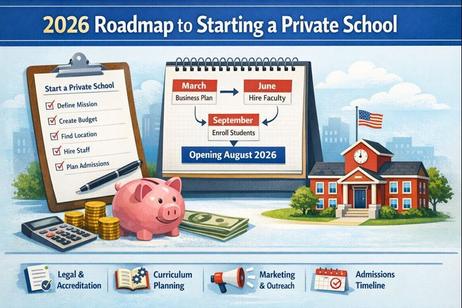
2025 Roadmap to Starting a Private School — Guide & Strategy

Updated
|
2025 Roadmap to Starting a Private School — Guide & Strategy
A 2025 step-by-step roadmap for launching your private school: strategy, funding, legal, curriculum, staffing, and sustainability insights.

A Roadmap for Starting a Private School in 2025

Launching a private school in 2025 requires not only a vision for academic excellence, but also a rigorous strategy to navigate evolving regulatory, financial, demographic, and competitive landscapes. Below, we update the classic roadmap to reflect 2025 realities, offering fresh insights, data, and real-world examples to guide founders, educators, and investors.

1. Clarify Mission, Vision & Market Niche

Reaffirm your “why.”
Begin with a clear mission: Are you founded on Montessori, STEM immersion, classical education, bilingual programming, or faith-based values? In 2025, parents increasingly seek schools that integrate social-emotional learning, global competency, and personalized pathways. A strong, differentiating mission helps you compete in a crowded marketplace.

Define your target market.
Conduct demographic research in your region: projected population growth in families with school-age children, income levels, and competitor density. For instance, in many U.S. metro regions, private school enrollment has not grown substantially: as of fall 2021, roughly 4.7 million students (9 percent of all K–12) were enrolled in private schools. In 2025, modest enrollment expansion is expected, so carving a niche — e.g. a hybrid in-person/digital academy, focused special education, or flexible hours — can help you stand out.

Paint your “positioning statement.”
Your school’s value proposition must be concise: e.g. “A bilingual STEAM lower school for first-generation immigrant families” or “A college-prep classical high school with year-round internships.”

2. Legal Structure, Accreditation & Compliance

Choose a legal entity.
Many new

. . .read more

Top 5 Mistakes Parents Make When Applying to Private Schools

Updated
|
Top 5 Mistakes Parents Make When Applying to Private Schools
Avoid the most common missteps families make during the private school admissions process. From starting too late to focusing on prestige over fit, this guide helps parents navigate applications with confidence and clarity.

Top 5 Mistakes Parents Make When Applying to Private Schools

Applying to private school is an exciting and often life-changing step for families. With multiple deadlines, interviews, and application components to manage, it's also a process that can be easy to misstep—especially for first-time applicants. While each school has its own admissions process, certain challenges tend to repeat. By recognizing the most common mistakes, you can reduce stress and present a stronger application for your child.

Here are the top five mistakes to avoid—and how to steer clear of them:

1. Starting the Process Too Late

Waiting too long to begin is one of the most common—and avoidable—errors. Private schools operate on specific timelines, often with fall and winter deadlines for the following academic year. Starting late can lead to:

  • Missing open house events or campus tours

  • Reduced financial aid options

  • Rushed essay and recommendation preparation

  • Overlooked school options due to time constraints

Tip: Begin researching schools 12–18 months before your desired start date. Mark key dates and create a calendar to keep everything on track. A helpful resource is our guide on how to evaluate a private school.

2. Focusing Too Much on Prestige — Instead of Fit

Many families chase well-known or highly ranked schools without considering whether they align with a child’s personality, learning

. . .read more

Admissions Matters: Following Up, The Competition, & Deadlines

Updated
|
Admissions Matters: Following Up, The Competition, & Deadlines
Navigating the complex landscape of private high school admissions requires expertise and insight. This article delves into essential areas that every school should master: inquiry follow-up, standing out in a competitive market, and choosing between rolling admissions and fixed admissions deadlines.

Navigating the complex landscape of private high school admissions requires expertise and insight. This article delves into essential areas that every school should master:

  • Inquiry follow-up
  • Standing out in a competitive market
  • Choosing between rolling admissions and fixed admissions deadlines

Discover effective strategies for personalized inquiry follow-ups that engage prospective families. Learn how to differentiate your school from competitors by identifying your unique selling points. Understand the implications of choosing rolling admissions or a fixed admissions deadline and what it means for your school's operations and appeal. Whether you are an admissions professional or a school leader, this article provides actionable insights to elevate your admissions process.

Inquiry Follow-up

Personalized Email Response

Acknowledge each inquiry with a personalized email response. Address the person by their name and answer any specific questions they might have asked. If they didn't ask any specific questions, briefly introduce the school and what it offers.

Regular Newsletters

Send regular newsletters about the school's activities, achievements, and updates. These could also include student testimonials, information about the faculty, and details about the curriculum. It's an excellent way to keep prospective students and parents engaged.

Phone Follow-Up

If the inquirer has provided a phone number, make a personal call after sending an initial email. Your call gives a personal touch and can help answer any immediate questions the person may have.

Virtual Information Sessions

Virtual information sessions can effectively give a more detailed overview of the school's offerings. Invite the inquirers to these sessions, where they

. . .read more

Recent Articles

Student Success Predictors at Community Colleges
A practical guide to student success predictors at community colleges for private school advisors helping graduates navigate two-year pathways.
Career Pathways with Community College for Private School Grads
Explore top career pathways with community college for private school graduates, including high-demand jobs, transfer options, and 2025 workforce trends.
Navigating the FAFSA & Financial Aid Timeline for Community College
Learn how to navigate FAFSA and financial aid timelines when starting at community college — from application to disbursement in 2025.