
Navigating Private School Finances: A Parent’s Guide (Updated for 2025)
Sending a child to a private school can be one of the most important financial decisions a family makes. With rising tuition rates, shifting enrollment, and growing financial-aid programs, understanding how to budget for private education is more critical than ever. This updated guide offers insights and practical recommendations for parents, students, and educators as of 2025 — based on the latest data, trends, and expert guidance.
Understanding the Cost Landscape in 2025
Tuition Trends Nationwide
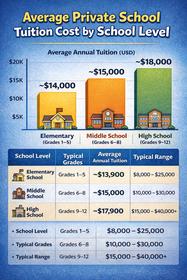
- The national average tuition for K–12 private schools in 2025–26 is about US$14,999 per year.
- For private elementary schools, the average is roughly US$14,018, while for private high schools it is about US$17,954.
- However, these averages mask wide variation: many day schools charge much more, and boarding schools often cost substantially more. A recent analysis found that some day schools now charge roughly US$49,284 annually, while boarding schools average around US$73,080. Bloomberg
- Among day-school families surveyed, nearly half reported tuition increases of 7 percent or more in the 2024–25 cycle — the most significant rise in a decade.
These figures illustrate that private school tuition continues to rise significantly, often outpacing general inflation and increasing household budget pressure.
Enrollment and Demographics
- As of fall 2021, approximately 4.7 million K–12 students were enrolled in private schools — roughly 9 percent of all U.S. K–12 enrollment.
- That number represented a slight increase compared with 2011, though there has been no strong long-term upward or downward trend overall. Council for American Private Education+1
- Among private school populations, enrollment is disproportionately higher among White, Asian, and students reporting two or more races than among Black, Hispanic, or American Indian/Alaska Native students. National Center for Education Statistics
- In 2024 and early 2025, private-school choice programs (vouchers, scholarship funds, etc.) grew in popularity: more than one million students nationwide are now reportedly receiving public or private support to attend private schools.
These shifts indicate that private schooling remains a significant and stable — though minority — component of the U.S. education system. At the same time, access remains uneven along racial and socioeconomic lines.
Decoding What Tuition Covers
Tuition is only one part of the financial picture. Families should consider additional costs and fees when budgeting for private education. Typical expenses beyond tuition may include:
- Administrative and registration fees;
- Books, supplies, uniforms, or technology charges;
- Transportation, after-school programs, extracurriculars, and athletics;
- For boarding schools: room and board, supervision, meals, and boarding-specific fees.
Because private tuition increases often reflect rising costs for staff, maintenance, and enhanced programming, families should anticipate that non-tuition expenses will rise as well. Experts recommend building a buffer of at least 10–15 percent above published tuition when setting a household budget, to accommodate ancillary costs.
Financial Aid, Scholarships, and Choice Programs
Growing Role of Financial Aid and Scholarships
Many private schools and independent school associations have expanded financial aid offerings in response to rising tuition and inflation. For example:
- Schools increasingly offer need-based grants and sliding-scale tuition adjustments;
- Some independent schools report providing substantial aid packages — sometimes averaging more than US$20,000 per eligible student per year. Yahoo+1
- A growing number of schools are also adding merit-based scholarships, athletic or arts-related awards, and loyalty discounts for siblings.
Public-Funded Choice Programs
The expansion of state-level voucher programs and education-savings accounts has reshaped the private school finance landscape. As of early 2025, more than one million U.S. students participate in such programs. EdChoice+1
These funds can significantly reduce the net cost of tuition and make private education accessible to families who otherwise could not afford full tuition.
Planning for Aid
When evaluating private schools, parents should:
- Request detailed financial-aid policies early, including deadlines, documentation requirements, and aid renewal conditions;
- Consider total out-of-pocket costs (tuition + fees + extras) after aid and weigh that against household budget and long-term financial goals;
- Explore external scholarships, community-sponsored grants, and state or local voucher/education-savings options.
Real-World Example: A Family Budget Scenario, 2025
Consider a family living in a mid-size U.S. city evaluating private high school for two children, grades 6 and 9.
- Published tuition per child: US$18,000 (slightly above national high-school average).
- Estimated additional fees (books, supplies, extracurriculars): US$2,500 per child.
- Family income qualifies them for 25 percent need-based aid.
Projected annual cost per child:
- Tuition after aid: $13,500
- Extra fees: $2,500
- Total: US$16,000
Total for both children: US$32,000 per year
Given potential tuition increases of 5–7 percent yearly, the family should budget for US$34,000–35,000 in subsequent years (assuming no additional financial aid changes).
This scenario underscores why many financial planners recommend families treat private school costs like a fixed long-term commitment rather than a one-time expense.
Why Private School Costs Are Rising
Several factors drive increasing private school tuition and fees:
- Operating costs: Higher wages, benefits for teachers and staff, inflation in utilities and maintenance, and growing support-staff needs.
- Enhanced programming: Expanded STEM, arts, athletics, mental health services, and advanced placement or international-baccalaureate programs.
- Competition and prestige: To remain competitive and attractive to families, many private schools invest in facilities, technology, and specialized offerings, which in turn raise costs.
- Smaller class sizes and individualized instruction: Parents often choose private schools for lower student-to-teacher ratios, but this requires more staffing per student — an inherently expensive structure.
Expert Advice for Parents Navigating Private School Finances
- Start early: Include private-school costs in long-term financial planning. Consider impacts on college savings, retirement, and overall household balance.
- Ask the right questions: What is total annual cost (tuition + fees)? How much does financial aid truly cover? Does the school increase tuition annually and by how much?
- Seek transparency: Request sample budgets, expense breakdowns, financial-aid renewal criteria, and scholarship options.
- Prioritize flexibility: Choose schools with clear aid policies, multi-year scholarships, or predictable fee structures. Families should avoid overcommitting in a way that jeopardizes future financial stability.
- Treat private schooling as an investment with trade-offs — academic benefits, community environment, class size — but also financial obligations.
As one private-school admissions consultant recently told us, “Choosing private school isn’t just about tuition — it is about long-term financial planning. Treat it like a mortgage, not a registration fee.”
Conclusion
In 2025, private school remains a significant investment. With average tuition nearing US$15,000 and many day and boarding schools charging far more, navigating private school finances requires careful planning, informed decision-making, and realistic budgeting.
Parents should understand the full cost picture tuition, fees, aid, and likely increases — and approach the decision with a long-term mindset. When managed responsibly, private schooling can provide academic, social, and developmental benefits that justify the cost. But clarity, transparency, and financial discipline remain essential.