Long-term Financial Planning

This section focuses on long-term financial considerations for parents, including tax implications, savings plans, and budgeting for private school education.

View the most popular articles in Long-term Financial Planning:

5 Changes In The Tax Act Of 2017 To Review

Updated
|
5 Changes In The Tax Act Of 2017 To Review
We identify changes in The Tax Cuts and Jobs Act of 2017 which impact not-for-profit private schools.

The Tax Cuts and Jobs Act of 2017 made many changes which impact charities and not-for-profit organizations such as private schools. Large private schools have expert tax advice at their disposal, as well they should. However, small private schools may not have a fulltime accountant on their staff. The point of this article is to encourage the administrators and trustees of small schools to discuss The Tax Cuts and Jobs Act of 2017 with tax and legal professionals at their earliest opportunity. These small schools need to understand what impact the new tax code has on their operations.

Here then are five items which I offer as talking points for your discussions.

1. The Impact On Charitable Giving

The Tax Cuts and Jobs Act – What Nonprofits Need to Know by Sandra Cyr in Philanthropy Journal News offers some insight into how the Tax Act might impact charitable giving. I use the verb "might" advisedly, because it is too soon as of this writing in July 2018 to know what the real impact on charitable giving will be. We will have a better idea about that in the spring of 2019. In the meantime, I suggest that you discuss giving with your board and try to develop a realistic plan. Don't assume that giving will stay the way it has been. Assume that it will change and be prepared for that change.
2.

. . .read more

The New Tax Code's Implications For 529 Plans For K-12 Schools

Updated
|
The New Tax Code's Implications For 529 Plans For K-12 Schools
Changes to the Tax Code in late 2017 included the addition of saving for K-12 private school education to 529 plans. We take a look at what this means for families thinking about private school for their children.

In December 2017 the 115th Congress of the United States passed a major act dealing with taxes. One of the changes in the Tax Code pertained to ESA or Educational Savings Accounts. Most parents and grandparents are probably familiar with ESAs as a means of saving for their children and grandchildren's college educations. Congress has expanded Section 529 ESAs to include K-12 education expenses as well as college expenses.

First, a bit of history. The educational savings accounts known as Section 529 plans were created by the Small Business Job Protection Act Of 1996. The section of this act which pertains to educational savings accounts is entitled PART VIII—QUALIFIED STATE TUITION PROGRAMS. The text begins on page 141. This is worth reading so that you can discuss the topic with your financial advisor when you set up your 529 plan.

Changes to the Tax Code

On Friday, December 22, 2017 President Donald Trump signed An Act to Provide for Reconciliation Pursuant to Titles II and V of the Concurrent Resolution on the Budget for Fiscal Year 2018 While the Act has effects on a wide range of tax situations, the specific text pertaining to K-12 educational expenses can be found on page 74. Here is the relevant paragraph:

‘‘(7) TREATMENT OF ELEMENTARY AND SECONDARY TUITION.—Any reference in this subsection to the term ‘qualified higher education expense’ shall include a reference to expenses for tuition in connection with enrollment or attendance at an

. . .read more

Before You Spend $30k on Private School...

Updated
|
Before You Spend $30k on Private School...
This article advises parents on key considerations before investing in private education. It covers topics such as academic results, curriculum alignment, student happiness, school financial stability, and payment options, emphasizing the importance of thorough research.

Before You Spend $30k on Private School...

As I have often said on these pages, finding the right private school for your child is a process and a daunting process at that. There are a great many factors to consider. So, before you spend $30,000 or more on a year at a private school for your child, you need to ask five questions and be guided by the answers you receive:

1. Does it get the results you want?
2. Does what the school teaches comply with your requirements?
3. Will your child be happy there?
4. Is the school financially stable?
5. How will you pay for it?

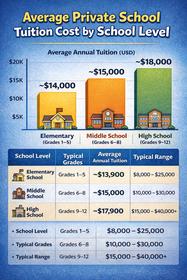
There is a bit more to the process, of course, but asking these five questions will get you started on the extensive due diligence that you must do before you spend approximately $150,000 for four years of private day school or roughly $200,000 for four years of boarding school. Tuition varies from school to school. Some are much less. Some a great deal more. Also, we are only discussing high school and middle school. The primary grades will run you $8,000 - $15,000, depending on the school.

Another point to consider is that private schools in the United States are not subsidized by government funding. So they will charge whatever the market forces and their budgets determine can be charged and needs to be charged. Be aware that most private schools offer generous financial aid programs. Some schools will even pay for

. . .read more

Recent Articles

Financial Aid 101 for Private School Families 2026
Guide to private school financial aid in 2026, with current costs, key planning timelines and practical steps parents need to maximize aid options.
Why Extracurricular Activities Matter in 2026
Discover why extracurricular activities remain essential in 2026, with updated research, costs, and admissions insights for parents and students.
How to Appeal for Financial Aid After Admission
Learn how to appeal for financial aid after admission to a private school, with expert steps, timelines, and 2026 updates for families.