


Private School Review Blog

How Much Unstructured Time Does Your Child Have? - Learn why unstructured time matters during a private school day, how recess, lunch, free periods, and transitions affect students, and what parents should evaluate before enrolling. (Updated Oct. 6, 2026)
What Happens When Bullying Continues Outside School? - Learn how private schools may respond when bullying continues through social media, texts, gaming, and off-campus activities, and what parents should document, report, and expect. (Updated Oct. 6, 2026)
How Private Schools Handle Food Allergies - Learn how private schools manage food allergies, from emergency plans and epinephrine access to cafeteria procedures, staff training, field trips, and the questions parents should verify before enrolling their child. (Updated Oct. 6, 2026)

Quick Facts (26-27)

Updated
|
COOP, HSPT and TACHS
You will encounter COOP, HSPT and TACHS if you are applying to some Roman Catholic high schools.

This article has been updated to reflect 2026 data and recent developments.

Many Roman Catholic high schools don't use the SSAT or ISEE admissions tests as part of their admissions requirements. For instance, Roman Catholic high schools in the Archdiocese of New York and the Diocese of Brooklyn administer the Test for Admission Into Catholic High Schools or TACHS.

The entrance examination used by a Catholic high school often depends on its location and the admissions system established by the diocese or individual school. Parents applying for the 2026-27 admissions cycle should check the requirements of each school carefully, including registration dates, application deadlines, and testing procedures. Private School Review's Admissions 101 provides an overview of the private school admissions process and the steps families should expect.

Elsewhere in the country, you will find the Cooperative Admissions Examination Program (COOP) or the High School Placement Test (HSPT). What the admissions staff are looking for is readiness for high school-level academic work. The tests are generally given in the late fall of grade 8.

Although entrance tests vary, they commonly assess skills students have developed throughout elementary and middle school. Families should confirm which examination is required before beginning test preparation because a school may use a particular test as part of a larger regional or diocesan admissions process.

Parents can also review A Parent's Guide to Private School Entrance Exams for additional information about admissions testing. Becoming familiar with the
. . .read more

The Oldest Schools

Updated
|
The Oldest Schools
The oldest schools are concentrated in the east in what were the original thirteen colonies. Most of the founders of these early schools were principled men and women with lofty ideals and purposes.

The oldest American private school is Collegiate School in Manhattan founded in 1628. Not surprisingly, the oldest schools are concentrated in the east in what were the original thirteen colonies. Most of the founders of these early schools were principled men and women with lofty ideals and purposes. Take John Phillips, for example.

Academy Mission Statement

"The founder of Phillips Exeter Academy defined its mission more than two centuries ago. 'Above all,' John Phillips stated, 'it is expected that the attention of instructors to the disposition of the minds and morals of the youth under their charge will exceed every other care; well considering that though goodness without knowledge is weak and feeble, yet knowledge without goodness is dangerous, and that both united form the noblest character, and lay the surest foundation of usefulness to mankind.'"

The Ursuline Academy was founded in New Orleans in 1727 because the Sisters of the Order of Saint Ursula were "Convinced that the education of women was essential to the development of a civilized, spiritual and just society." These schools established so long ago are a lasting tribute to the vision of these early founders. Here then in their own words are the oldest schools.

1628 - Collegiate School

Collegiate School

"Collegiate School, a day school for boys, is the oldest independent school in the United States. Tracing its origins to 1628, the school was established by the Dutch West India Company and the Classis of Amsterdam, the parent ecclesiastical

. . .read more

Schools For The Arts

Updated
|
Schools For The Arts
Schools for the artistically gifted child are in short supply.

Schools for the artistically gifted child are in short supply. If you have a daughter inclined to things thespian or a son who sings, then you ought to consider a school which makes the arts its raison d'etre, a place where the arts are not just a pleasant extracurricular activity.

These specialist private schools arrange their academic day around serious time for the arts. Plenty of rehearsal time is a must. Exciting recital and performance opportunities abound. Expert instruction is de rigeur. This short video explains why arts are important.

Here are descriptions of the schools in their own words. Be sure to click on the links to read more about each school on this list.

Adda Clevenger Junior Prep & Theater School, San Francisco

Adda Clevenger Junior Prep & Theater School, San Francisco

"All students of the school are members of the Adda Clevenger Youth Chorus of San Francisco under the direction of Alexis Murphy-Egri. In addition to a well-rounded musical education including music theory, vocal coaching and dramatic interpretation, it is essential that choristers also have many opportunities to perform. The repertoire consists of a wide range of genres including classical, sacred, folk, theater, and current popular music."

The Conservatory, Baltimore Actors' Theatre, Baltimore

The Conservatory, Baltimore Actors' Theatre, Baltimore

"The Conservatory, Baltimore Actors' Theatre, is Maryland's first and only accredited College Preparatory School of the Arts, for

. . .read more

Waldorf Schools

Updated
|
Waldorf Schools
Waldorf schools offer a well thought out approach to K-12 education.

Disclaimer: My eldest daughter attended the Waldorf School of Garden City back in the 70s. We liked the gentle approach that allowed children to explore and learn to think critically. ~Rob Kennedy

Waldorf schools offer a well-thought-out approach to K-12 education. Unlike Montessori schools, which focus on the primary grades, Waldorf schools cover all the grades. The Waldorf movement got its start with the writings and philosophy of Rudolph Steiner (1861-1925). Pictured on the right, Steiner was an Austrian-born philosopher who founded a movement known as anthroposophy.

One of the key aims of our method of educating is to help the child toward developing the faculty of free imagination. So, for example, we generally tell stories without offering printed pictures. Our words provide the raw materials. The child has to “clothe” the story with his or her own images. ( Mt Barker Waldorf School Parent Association 2001 )

This video from the Spring Garden Waldorf Schools gives an overview of a Waldorf education.

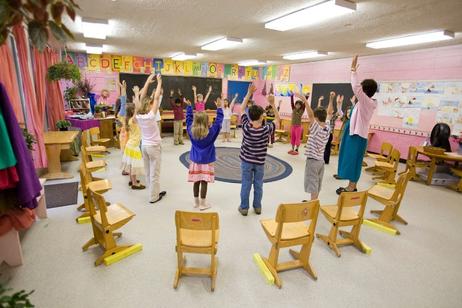
The essence of the Waldorf approach to education is its emphasis on developing a child's imagination and creative side. The Waldorf pedagogues prefer that young children never be exposed to popular entertainment such as television, popular music, and computers. Competition is replaced with cooperation. Eurythmy, an expressive music cum dance art form, plays a central role in developing a child's artistic expression. The whole child is

. . .read more

Montessori Schools

Updated
|
Montessori Schools
Montessori schools are popular world-wide with parents of children in the primary grades.

Montessori schools are popular worldwide with parents of children in the primary grades. Interestingly enough, the educational concepts pioneered and codified by Dr. Maria Montessori (1870-1952) decades ago to educate mentally disabled and ineducable children in the inner city have morphed into a kind of schooling generally available only to middle and upper-class families nowadays.

How do I know a school is a genuine Montessori school?

Caveat emptor! Not every school which claims to be a Montessori school adheres to the founder's standards and methods. That is because the name Montessori has never been protected by trademark or copyright law. As a result, you can have a Montessori school with any strength of Montessori-ness you can imagine. In truth, the genuine article is a school member of the American Montessori Society. The association will have officially sanctioned it. It will have certified Montessori teachers using Montessori methods and equipment. That is not to say that a school that claims to be a Montessori school but is not part of the national association is any less good or adequate. That, as always, depends on the quality of the teachers and teaching. Remember that Montessori has become a household name, much like 'Xerox,' which is synonymous with 'copying.'

What is so appealing to parents about the Montessori method?

What, then, is so appealing about Dr. Montessori's methods? At the heart of her philosophy is that children learn differently from adults and should be allowed to learn wherever and whatever their

. . .read more

Recent Articles

How Much Unstructured Time Does Your Child Have?
Learn why unstructured time matters during a private school day, how recess, lunch, free periods, and transitions affect students, and what parents should evaluate before enrolling.
What Happens When Bullying Continues Outside School?
Learn how private schools may respond when bullying continues through social media, texts, gaming, and off-campus activities, and what parents should document, report, and expect.
How Private Schools Handle Food Allergies
Learn how private schools manage food allergies, from emergency plans and epinephrine access to cafeteria procedures, staff training, field trips, and the questions parents should verify before enrolling their child.