The Journey to Enrollment

This cluster offers a roadmap for applying to private schools, providing parents and students with insights and guidance to navigate the complexities of research, applications, and final enrollment.

View the most popular articles in The Journey to Enrollment:

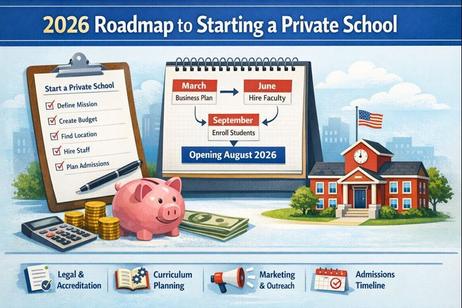
2026 Roadmap to Starting a Private School

Updated
|
2026 Roadmap to Starting a Private School
A 2026 guide to launching a private school, covering planning, costs, admissions timing, governance, and trends parents care about now.

2026 Roadmap to Starting a Private School, Guide and Strategy

Launching a private school in 2026 requires more than a compelling educational vision. Founders must respond to shifting parent expectations, rising operational costs, evolving regulations, and increasingly competitive admissions cycles. Families are asking sharper questions about value, access, outcomes, and timing. At the same time, schools face pressure to differentiate while remaining financially sustainable.

This updated roadmap retains the strategic structure of prior guidance while reflecting current academic cycles, cost realities, and policy considerations. It is designed for founders, board members, and education leaders planning a new private school opening in the 2026 to 2027 academic year or beyond.

Clarify Your Mission and Market Position

Every successful private school begins with a clear mission that addresses a specific educational need. In 2026, that need is often tied to academic rigor, student well-being, and future readiness. Parents increasingly seek schools that balance strong academics with social-emotional learning, experiential programs, and transparent outcomes.

Market research should go beyond identifying nearby competitors. Analyze enrollment trends, tuition ranges, grade-level demand, and unmet needs in your region. Consider whether your school will serve a niche population, such as language immersion, STEM-focused learners, or students seeking smaller class environments, or whether it will compete directly with established independent schools.

Expert perspective from school consultants suggests that new schools with clearly differentiated missions reach enrollment stability faster than generalist models. Clarity also strengthens fundraising, admissions messaging, and faculty recruitment.

. . .read more

Mental Health & Wellness Support in Private Schools: Key Questions for Parents

Updated
|
Mental Health & Wellness Support in Private Schools: Key Questions for Parents
Discover essential questions about mental health & wellness support in private schools before enrolling, with 2026 updates for informed decisions.

Mental Health & Wellness Support in Private Schools: What to Ask Before Enrolling

Choosing the right private school for your child involves more than academics, athletics, and arts. Today, parents and guardians increasingly prioritize mental health & wellness support in private schools as a core criterion in the enrollment decision. The 2026 landscape of student wellness emphasizes comprehensive, proactive, and culturally responsive support systems. In this article, we explore what mental health & wellness support in private schools should look like, why it matters, and the most important questions to ask before enrolling your child.

Why Mental Health & Wellness Support in Private Schools Matters

Mental health and wellness are foundational to a student’s academic success, social development, and long-term well-being. National data shows that rates of anxiety, depression, and stress-related conditions among school-aged children have risen in recent years. Private schools, with typically smaller class sizes and greater resources, have both the opportunity and responsibility to provide robust mental health & wellness support in private schools.

Research published by the Centers for Disease Control and Prevention highlights the link between supportive school environments and reduced risk of mental health challenges. Creating a culture of care not only helps students who are struggling but fosters resilience in all learners.

Core Components of Mental Health & Wellness Support in Private Schools

Before enrolling, it’s important to understand what effective mental health & wellness support in private schools entails. Look for programs

. . .read more

Enrollment Trends 2026: Private School Admissions Outlook

Updated
|
Enrollment Trends 2026: Private School Admissions Outlook
Enrollment Trends 2026 analysis explains why private schools are seeing enrollment growth or decline and what families should know.

Enrollment Trends 2026: What’s Causing Declines or Growth in Private School Admissions

Private school enrollment has entered a period of recalibration. Enrollment Trends 2026 reveal a sector shaped by demographic shifts, economic pressures, evolving parental priorities, and changing public education dynamics. For some schools, Enrollment Trends 2026 point to renewed growth and waitlists. For others, Enrollment Trends 2026 signal enrollment softness and increased competition for families.

Understanding Enrollment Trends 2026 is essential for parents evaluating private education, for school leaders planning strategically, and for educators responding to new expectations. While national enrollment numbers tell part of the story, Enrollment Trends 2026 vary widely by region, grade level, and school mission.

This analysis examines the forces shaping Enrollment Trends 2026, why some private schools are growing while others are contracting, and what these patterns mean for admissions in the years ahead.

A Snapshot of Enrollment Trends 2026

Enrollment Trends 2026 show a private school sector that is neither uniformly declining nor universally expanding. Instead, Enrollment Trends 2026 highlight divergence.

According to data from the National Center for Education Statistics and independent school associations, private school enrollment nationally remains below pre-pandemic highs, but stabilization is underway. Enrollment Trends 2026 indicate that early childhood and elementary programs are rebounding faster than middle and high school programs. Faith-based schools are seeing steadier Enrollment Trends 2026 than many independent secular schools, largely due to tuition affordability and strong community ties.

At the same time, Enrollment Trends

. . .read more

First Semester Community College Survival Tips 2026

Updated
|
First Semester Community College Survival Tips 2026
Essential 2026-updated expert tips to thrive in your first community college semester, from scheduling to finances and support resources.

4 Indispensable Tips for Surviving Your 1st Semester of Community College (2026 Update)

Starting community college is a milestone filled with promise and pressure. As we navigate the evolving landscape of higher education in 2026, today’s students face both familiar challenges and new realities — from shifting financial aid practices to expanded digital learning environments. This updated guide offers practical, research-backed strategies to help students, parents, and educators succeed in that critical first semester.

1. Master Time, Balance, and Academic Rigor

Community college coursework demands intentional time management. Unlike many high school schedules, college pacing requires students to take ownership of their study habits and outside-class responsibilities.

Set a realistic schedule:
Experts recommend students plan far beyond class times. For example, Dr. Robert R. Neuman, PhD, author and higher education specialist, suggests students budget 4 to 6 hours of study per week for each three-credit course. This means a typical 12-credit semester could require 16–24 hours of study time weekly — on top of classes and personal responsibilities.

Balance work, school, and life:
Many community college students juggle employment, family obligations, and commuting. According to national trends, the average community college student is 27 years old and often attends part-time due to work or family commitments. Hidden costs such as transportation, child care, or housing can stretch students thin physically and financially.

Weekly planning tools:
Use a digital calendar or planner that consolidates class schedules, assignments, work shifts, and personal time. This increases visibility

. . .read more

What to Expect Your First Semester of Community College (2026 Guide)

Updated
|
What to Expect Your First Semester of Community College (2026 Guide)
A 2026 parent and student guide to your first semester at community college—tuition, support services, academics, social life, and success strategies.

What to Expect Your First Semester of Community College (2026 Update)

Starting community college is an exciting transition for many students and families. Whether your goal is to earn a degree, gain valuable career skills, or prepare for transfer to a four-year university, understanding what to expect can make your first semester more successful and less stressful. This updated 2026 guide offers evidence-based insights, practical tips, and expert orientation advice for parents, students, and educators navigating the modern two-year college experience.

The Evolving Landscape of Community College in 2026

Community colleges continue to be engines of opportunity and affordability in U.S. higher education. After years of enrollment fluctuation, the sector has seen renewed participation. Recent data indicate overall community college enrollment grew by roughly 3.9 percent from fall 2023 to fall 2024, with approximately 10.5 million students enrolled in credit and non-credit programs combined. Many of these students are younger (average age now around 19–20), including a growing number of high school dual-enrollees.

At the same time, short-term credentials and career-focused programs are gaining traction as students seek faster pathways to employment, while traditional transfer pathways remain vital for many who plan to complete a bachelor’s degree.

Understanding Your Costs: Beyond Tuition

One of community college’s biggest advantages is affordability, but costs extend beyond sticker tuition.

Tuition and Fees

In 2025, the average annual tuition and fees for public community colleges nationwide were about $5,159 for in-state residents

. . .read more

Recent Articles

How Private Schools Are Preventing Student Burnout
Discover how private schools are addressing student burnout through wellness programs, balanced academics, and expanded mental health support.
How Private Schools Evaluate “Soft Skills” Like Leadership and Grit
Learn how private schools assess leadership, grit, resilience, and character, and why these soft skills are becoming increasingly important in admissions.
How Private Schools Handle Cell Phones: Why Phone-Free Campuses Are Growing
Discover how private schools manage cell phones, why phone-free campuses are growing, and how reduced social media access can benefit students.

The Journey to Enrollment

THE ADMISSIONS PROCESS
This section outlines the step-by-step journey of applying to private schools, from understanding the overall process to preparing for interviews and meeting crucial deadlines. It offers valuable insights and tips to help applicants navigate each stage successfully.
APPLICATION COMPONENTS
Here, we delve into the specific elements that make up a private school application. This subheading covers everything from personal statements to recommendation letters, providing guidance on how to approach each component effectively.
ENROLLMENT MANAGEMENT
This subheading focuses on the administrative side of admissions, exploring topics such as enrollment agreements and rolling admissions. It's particularly useful for school administrators and parents wanting to understand the enrollment process from an institutional perspective.
ACCEPTED, WAITLISTED,REJECTED
This section addresses how to handle the school's decision to your admissions application.
SCHOOL VISITS
Visiting the schools you are considering is an essential part of choosing a school for your child.
INTERNATIONAL APPLICANTS
This group includes articles about the admissions process for international students as well as articles about the visa requirements.