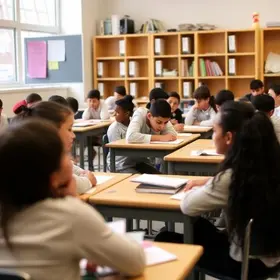
School Life

Get a glimpse of private school life. Here you'll find a survival guide for parents, brush up on terms and jargon, and learn why extracurricular activities are so important.

View the most popular articles in School Life:

How Private Schools Handle Food Allergies

Updated
|
How Private Schools Handle Food Allergies
Learn how private schools manage food allergies, from emergency plans and epinephrine access to cafeteria procedures, staff training, field trips, and the questions parents should verify before enrolling their child.

For parents of a child with a food allergy, choosing a private school involves questions that may never appear in an admissions brochure. Academic programs, class size, extracurricular activities, and school culture matter, but so does knowing exactly what will happen if your child is accidentally exposed to an allergen.

Food allergy policies can vary considerably from one private school to another. Some schools have full-time nurses, detailed allergy management procedures, trained food service teams, and stock epinephrine. Others may rely on administrators, teachers, or designated staff members to handle medical needs.

Parents should therefore evaluate food allergy management as carefully as they evaluate academics and school culture. Before enrolling, ask how the school's policies actually work during an ordinary school day, and during an emergency.

Start With the School's Written Food Allergy Policy

Do not rely solely on an admissions representative saying, "We handle food allergies all the time." Ask to see the school's written policy.

The Centers for Disease Control and Prevention recommends that schools address five broad areas, including daily management of individual students, preparation for emergencies, staff professional development, education for students and families, and creation of a safe school environment.

Parents should determine whether a prospective private school's procedures cover those same areas.

Ask who is responsible for coordinating allergy management and whether each student with a diagnosed food allergy has an individual emergency plan. You should also know how that information reaches teachers, substitute teachers, coaches, cafeteria employees, transportation staff,
. . .read more

Who Handles Medication at a Private School?

Updated
|
Who Handles Medication at a Private School?
Learn who handles student medication at private schools, what policies families should review, and which questions parents should ask about prescriptions, emergencies, storage, documentation, and daily administration.

A child who needs medication during the school day adds an important question to the private school search: Who will actually administer it?

The answer is not always simply "the school nurse." Private schools differ in staffing, health-office coverage, medication policies, and procedures for field trips and extracurricular activities. State laws and regulations can also affect who is permitted to administer medication and under what circumstances.

For parents, the important task is to understand the school's actual procedure before enrolling. A medication policy should explain who is responsible, what documentation is required, where medicine is stored, and what happens when the usual health professional is unavailable.

That information becomes particularly important for students who take medication every day or need immediate access to emergency medicine.

Start With the School's Written Medication Policy

Do not rely solely on an admissions officer saying, "We can handle that."

Request the school's written health or medication policy. It may appear in the parent-student handbook, enrollment materials, or health-office documentation.

Private School Review's guide to private school handbooks explains why families should review these documents carefully. School handbooks often contain detailed rules and procedures that families may not encounter during a campus tour.

Look for specific answers. Does medication have to remain in its original pharmacy container? Is written authorization from a parent required? Does the school require instructions from the prescribing clinician? Where is medication stored? Can students carry certain emergency medications?

The American Academy of Pediatrics

. . .read more

Does Your Child Need a School With a Full-Time Nurse?

Updated
|
Does Your Child Need a School With a Full-Time Nurse?
Learn when a full-time school nurse matters, how private schools handle medications, chronic conditions and emergencies, and which health-service questions parents should ask before enrolling their child.

When families compare private schools, they often focus first on academics, class size, tuition, extracurricular activities, and school culture. Health services may receive much less attention. Yet for some children, the difference between having a full-time nurse on campus and having limited nursing coverage can affect daily safety, attendance, and a family's confidence in the school.

The question is not simply whether a school "has a nurse." Parents need to know who is available during the entire school day, what qualifications that person holds, how medications are administered, and who responds when the health professional is absent.

For a healthy child with few medical needs, limited nursing coverage may be workable when a school has strong emergency procedures and trained staff. For a student with diabetes, severe allergies, epilepsy, asthma, or another condition requiring regular monitoring, full-time nursing coverage may carry much greater importance.

The goal is to understand exactly what health support your child would receive on an ordinary Tuesday, not simply what appears in an admissions brochure.

What Does "We Have a School Nurse" Actually Mean?

Start by defining the phrase.

A school might employ a registered nurse who remains on campus throughout the school day. Another may have a nurse who divides time among campuses. Some schools use a part-time nurse, while others designate trained administrators or other staff to manage routine health needs when no nurse is present.

These arrangements are not equivalent.

According to the Centers for Disease Control and

. . .read more

Will My Child Find Their People? Evaluating School Culture

Updated
|
Will My Child Find Their People? Evaluating School Culture
Learn how to evaluate private school culture, student belonging, friendships, teacher relationships, social dynamics, and authentic community fit so your child can find the right place to thrive and connect.

A private school website can tell you about class size, advanced courses, athletics, arts programs, and college outcomes. It can show smiling students gathered around laboratory tables, performing onstage, or talking beneath autumn trees. What it cannot easily tell you is whether your child will walk into school on an ordinary Tuesday and feel that they belong.

For many families, "Will my child find their people?" is ultimately a question about private school culture. Will some classmates share their interests? Adults who notice when something is wrong? Room for a quiet child, a highly driven student, an unconventional thinker, or someone still figuring out who they are?

Those questions deserve as much attention as academics. The challenge is learning how to evaluate the culture students actually experience rather than the culture presented in admissions materials.

Why Belonging Deserves a Place on Your School Checklist

Belonging is not simply about whether a child makes friends quickly. It reflects whether students believe that people within the school know them, value them, and care about their learning.

The Centers for Disease Control and Prevention describes school connectedness as the feeling that adults and peers at school care about students as individuals and about their learning. Its November 2024 guidance notes that students who feel connected to school are more likely to have stronger attendance and academic outcomes and are less likely to experience several health and behavioral risks.

That makes culture more than an admissions-era question about whether

. . .read more

AI Tutoring in Private Schools: Innovation or Risk?

Updated
|
AI Tutoring in Private Schools: Innovation or Risk?
Discover how AI tutoring is changing private education, the benefits and risks for students, and what parents should ask before enrolling.

Artificial intelligence is transforming education at a remarkable pace, and one of its fastest-growing applications is AI-powered tutoring. From personalized math instruction to instant writing feedback, these tools promise to give students individualized support whenever they need it. As more private schools incorporate AI into their academic programs, parents are beginning to ask an important question: Does AI tutoring improve learning, or does it introduce new risks?

The answer is not as simple as choosing between technology and traditional teaching. The most successful private schools are using AI tutoring as a supplement rather than a substitute for experienced educators. When thoughtfully implemented, AI can reinforce classroom instruction, identify learning gaps, and provide students with additional practice. However, concerns surrounding data privacy, academic integrity, and overreliance on technology remain significant considerations for families.

According to the International Society for Technology in Education (ISTE), artificial intelligence should enhance teaching and learning while keeping educators at the center of the educational experience. Similarly, the U.S. Department of Education has emphasized that schools should adopt AI responsibly, ensuring that technology supports educational goals without compromising student privacy or equity.

What Is AI Tutoring?

Unlike traditional online learning platforms that simply present digital lessons, AI tutoring systems adapt to each student's performance in real time. As students answer questions or complete assignments, the software analyzes their progress and adjusts future instruction based on individual strengths and weaknesses.

For example, a student struggling with algebra may receive additional practice problems

. . .read more

Recent Articles

Should Your Child Stay at the Same Private School K–12?
Explore whether your child should attend the same private school from kindergarten through graduation, weighing academic continuity, friendships, changing needs, tuition costs, and opportunities at different educational stages.
When Your Child's Closest Friends Leave Private School
Learn how to support your child when close friends leave private school, manage loneliness, maintain friendships, encourage new connections, recognize emotional challenges, and decide when additional school support is needed.
When Your Child Doesn't Connect With Their Teacher
Discover when parents should intervene if their child struggles to connect with a private school teacher, including warning signs, communication strategies, classroom concerns, and practical steps toward improving relationships.

Why Private School